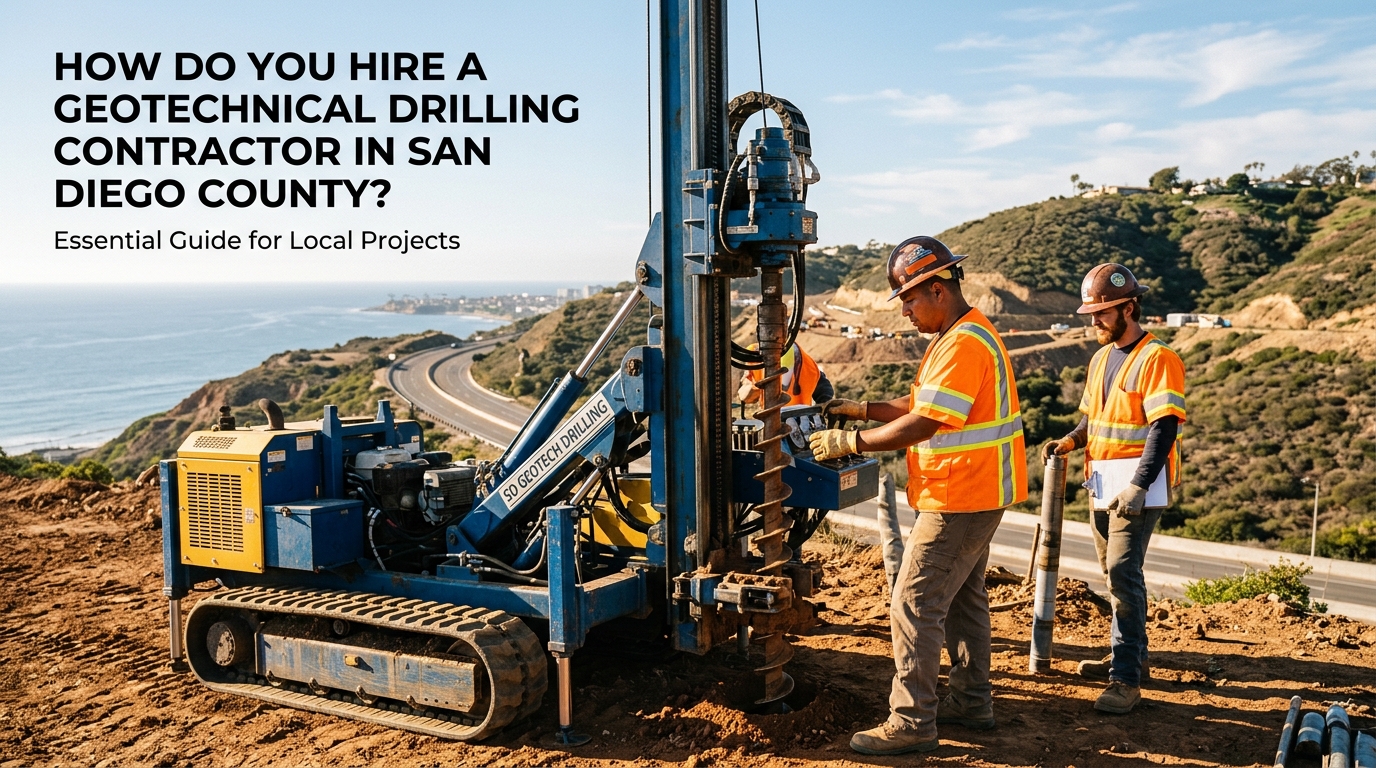
How Do You Hire a Geotechnical Drilling Contractor in San Diego County?
You can hire a qualified geotechnical drilling contractor in San Diego County within 2 to 3 weeks by following seven verification steps. This process suits beginners and experienced project managers alike. No prior geotechnical experience is required, but basic understanding of your construction project scope helps streamline contractor selection.
Before You Begin: Prerequisites Checklist
- Project documentation: Site plans, proposed structure type, and construction timeline
- Budget range: Typical geotechnical investigation cost estimates in San Diego run $3,000–$15,000 for residential projects and $15,000–$75,000+ for commercial sites
- Permit awareness: Know whether your site requires a San Diego County soil boring permit before drilling begins
- Timeline flexibility: Allow 2-4 weeks for report turnaround after fieldwork completion
- Decision-maker access: Have authority to sign contracts or fast access to someone who does
Step 1: Define Your Geotechnical Investigation Scope
Determine what type of subsurface exploration your project requires before contacting contractors. According to NAVFAC design manuals (2024), foundation type and soil conditions dictate testing methods.
1.1 Identify Your Project Type
Residential foundation testing differs significantly from commercial geotechnical services California requirements. Single-family homes typically need basic soil boring and Standard Penetration Test (SPT) data. Commercial and multi-story buildings often require Cone Penetration Testing (CPT) combined with seismic soil analysis.
1.2 Determine Testing Requirements
Ask whether your site falls within a Seismic Hazard Zone as mapped by the CGS California Geological Survey. Properties in these zones require additional slope stability analysis and liquefaction assessment under California Building Code Chapter 18.
Step 2: Verify Licensing and Insurance Credentials
Confirm the drilling contractor holds an active California Contractors State License Board (CSLB) license before requesting quotes.
2.1 Check CSLB License Status
Search the CSLB website using the contractor’s license number. A licensed drilling contractor should hold a C-57 (Well Drilling) or A (General Engineering) classification depending on project scope.
2.2 Confirm Insurance Coverage
Request proof of general liability insurance (minimum $1 million recommended) and workers’ compensation coverage. This step verifies drilling safety compliance standards required for construction site drilling operations.
Step 3: Evaluate Technical Qualifications and Standards Compliance
A qualified geotechnical drilling company must demonstrate adherence to industry benchmarks.
3.1 Confirm ASTM Standards Compliance
Verify the contractor follows ASTM Standards for soil sampling, including ASTM D1586 (SPT) and ASTM D3441 (CPT). Non-compliant testing methods can invalidate your geotechnical report for permitting purposes.
3.2 Review Staff Credentials
Confirm the firm employs or partners with a licensed Geotechnical Engineer registered in California. Field technicians should have documented training in soil mechanics testing procedures.
3.3 Check OSHPD and Caltrans Experience
For institutional or infrastructure projects, ask whether the contractor has prior OSHPD (Office of Statewide Health Planning and Development) or Caltrans project experience. This demonstrates familiarity with public-sector geotechnical investigation standards.
Step 4: Request Proposals and Compare Drilling Methods
Contact at least three companies to compare pricing, equipment, and approach.
4.1 Request Detailed Scope of Work
Ask each engineering geology firm to specify:
- Number and depth of soil borings planned
- Drill rig type (truck-mounted, track-mounted, or limited-access rig)
- Testing methods (SPT, CPT, or combined approach)
- Laboratory testing included via an accredited geotechnical testing lab
- Estimated timeline from mobilization to final report
4.2 Compare Equipment Capabilities
Confirm the contractor’s drill rig fleet matches your site conditions. Limited-access sites require smaller rigs, while open commercial lots accommodate standard truck-mounted equipment. Reputable firms often offer drilling equipment rental transparency, showing exactly what machinery will be used.
Step 5: Review Sample Reports and Environmental Capabilities
Request a sample geotechnical report from a prior project similar to yours.
5.1 Assess Report Quality
A strong site investigation report includes boring logs, laboratory data, foundation design recommendations, and slope stability analysis where applicable. Reports lacking clear engineering conclusions signal weak geotechnical consulting capability.
5.2 Confirm Environmental Drilling Services
If your project involves contamination concerns, verify the contractor offers environmental site assessment capabilities, including monitoring wells installation and groundwater testing. Not all soil boring contractors provide environmental drilling services, so confirm this early if needed.
Step 6: Confirm Permits and Safety Compliance
Clarify who handles the permit for drilling San Diego County — you or the contractor.
6.1 Understand the San Diego County Soil Boring Permit Process
Most jurisdictions in San Diego County require a drilling permit before subsurface exploration begins. According to the County of San Diego Department of Environmental Health (2024), permits typically process within 5-10 business days.
6.2 Verify Safety Protocols
Ask about underground utility locating (Underground Service Alert/Dig Alert), site traffic control plans, and OSHA-compliant drilling safety compliance procedures.
Step 7: Finalize Contract and Schedule Fieldwork
Once you’ve selected your preferred local drilling company, formalize the agreement.
7.1 Review Contract Terms
Ensure the contract specifies scope, cost, timeline, and report delivery date in writing. Include a cancellation clause and change-order process for unexpected drilling conditions.
7.2 Schedule Site Access
Coordinate site access, utility clearance, and equipment mobilization dates. Most residential projects complete fieldwork within 1-2 days; commercial sites may require 3-5 days depending on boring count.
For projects requiring proven local expertise, many property owners choose a geotechnical drilling contractor San Diego teams trust for combining CSLB-licensed operations with ASTM-compliant testing protocols.
Troubleshooting Common Hiring Issues
If a contractor can’t verify CSLB licensing → Do not proceed
Request the license number directly and cross-check it on the CSLB website. Unlicensed operators create legal liability for property owners.
If quotes vary widely between contractors → Compare scope, not just price
A quote 40% lower than competitors often means fewer borings or reduced laboratory testing. Request itemized scope of work from each bidder.
If permit approval is delayed → Confirm application completeness
Missing site plans or incorrect zoning information cause most San Diego County soil boring permit process delays. Contact the county permit office directly to confirm status.
If drilling encounters unexpected conditions (rock, groundwater) → Request a change order
Subsurface conditions like shallow bedrock or high groundwater tables may require modified drilling equipment or additional time. A qualified contractor will document conditions and propose adjusted scope before continuing.
If the final report lacks clear recommendations → Request revision
A complete geotechnical report must include specific foundation design guidance. Vague or generic conclusions indicate the firm may lack qualified engineering review.
Next Steps After Hiring Your Contractor
- Schedule a pre-drilling site walk with the contractor and project engineer
- Confirm underground utility clearance (Dig Alert) at least 48 hours before drilling
- Request interim field notes if your timeline is compressed
- Share the completed geotechnical report with your structural engineer and architect
- Retain the report for future permitting, refinancing, or property disclosure needs
Frequently Asked Questions
What Does a Geotechnical Drilling Contractor Do?
A geotechnical drilling contractor performs subsurface exploration through soil boring, sampling, and in-situ testing to determine soil bearing capacity, groundwater conditions, and seismic hazard potential for construction projects.
How Long Does Geotechnical Drilling Take?
Fieldwork typically takes 1-2 days for residential projects and 3-5 days for commercial sites. Full report preparation adds 2-4 additional weeks depending on laboratory testing complexity.
How Do I Verify a Drilling Contractor’s License in California?
Visit the CSLB website (cslb.ca.gov) and search by license number or company name to confirm active status, classification, and insurance bonding.