Is a Geotechnical Investigation Worth It for Your San Diego ADU? 2025 Cost, Benefits & Verdict
A geotechnical investigation is worth the cost if your Accessory Dwelling Unit (ADU) sits on a hillside lot, in a mapped liquefaction zone, near an Alquist-Priolo Earthquake Fault Zoning Act fault, or on expansive soils. If your parcel is flat, has documented stable soils, and falls outside a geologic hazard zone overlay, several San Diego jurisdictions will waive the soil report requirement entirely. This guide breaks down exactly which San Diego jurisdictions require a geotechnical report for ADU construction, what it costs in 2025, and whether the investment pays off.
Which San Diego Jurisdictions Require a Geotechnical Investigation for an ADU?

Requirements vary significantly across San Diego County. Below is a jurisdiction-by-jurisdiction summary based on published 2024–2025 building department ADU checklists.
| Jurisdiction | Geotechnical Report Required? | Primary Trigger |
|---|---|---|
| City of San Diego | Conditional | Hillside development review, liquefaction zone San Diego mapping |
| San Diego County (unincorporated) | Conditional | Slope >15%, geologic hazard zone overlay |
| City of Chula Vista | Conditional | Expansive soils San Diego, fault zone setback |
| City of Carlsbad | Conditional | Coastal bluff, liquefaction potential |
| City of Oceanside | Conditional | Slope stability analysis for hillside ADU construction |
| City of Encinitas | Yes, often required | Bluff-top and hillside lot ADU construction |
| City of Poway | Conditional | Steep terrain, soil bearing capacity concerns |
| City of La Mesa | Rarely required | Only flagged parcels near known faults |
| City of Santee | Conditional | Hillside lots, fill soil history |
| City of El Cajon | Rarely required | Flat-lot majority, low seismic hazard designation |
| City of San Marcos | Conditional | Grading permit requirements trigger review |
| City of Escondido | Conditional | Hillside overlay zones, expansive clay soils |
Across nearly every jurisdiction, the deciding factor is not the ADU itself but the site conditions: proximity to an Alquist-Priolo Earthquake Fault Zoning Act zone, inclusion in California Geological Survey liquefaction zone maps, or a slope exceeding local hillside development review thresholds.
What You Get With a San Diego ADU Geotechnical Investigation

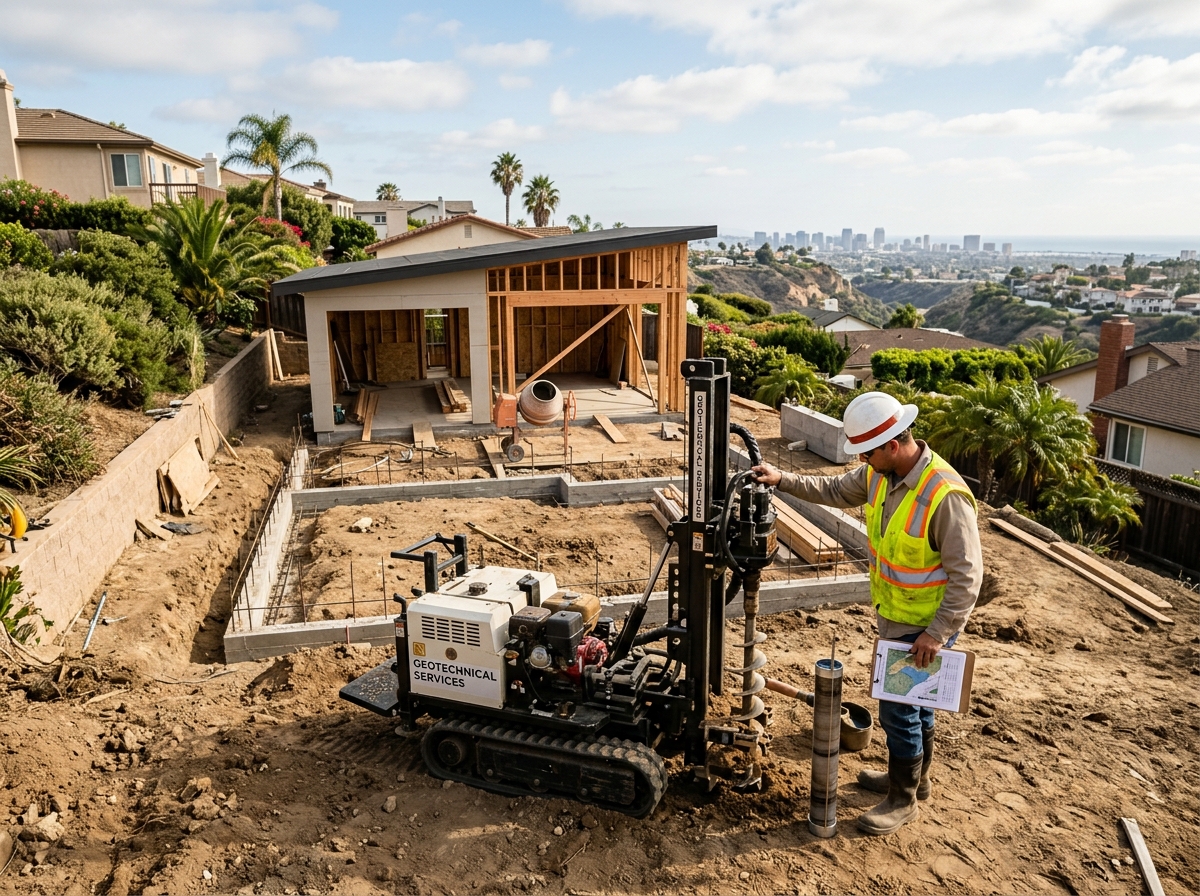
A site-specific soils investigation performed by a licensed geotechnical engineer or soils engineer typically includes the following deliverables.
Included in a Standard Geotechnical Report ADU Package
- Soil boring or test pit sampling and soil compaction testing
- Foundation design requirements tailored to soil bearing capacity
- Liquefaction potential and seismic design category classification
- Expansive soil mitigation measures and grading recommendations
- A stamped geologic hazard report submitted to the Development Services Department or Building and Safety Department
Extras Not Automatically Included
- Slope stability report for steep hillside lots (often billed separately)
- Engineering geology report for fault-adjacent parcels
- Geotechnical peer review, sometimes mandated by the City Building Official for high-risk sites
- Grading permit requirements documentation for cut/fill over regulatory thresholds
- Site grading and drainage plan integration with structural foundation requirements ADU
Homeowners planning construction on a hillside lot should also budget for coordination between the geotechnical engineer and a structural engineer, since foundation design must reconcile both soil conditions and seismic loading under the California Building Code.
Cost Breakdown: San Diego ADU Geotechnical Investigation Pricing in 2025
Costs vary by lot complexity, access, and jurisdiction review depth. Based on 2024–2025 market rates across San Diego County:
- Flat lot, low-hazard zone: $1,500–$2,800 for a basic site-specific soils investigation
- Moderate complexity (grading involved): $2,800–$4,200, including soil compaction testing
- Hillside or liquefaction zone parcel: $4,200–$6,500+, including slope stability analysis
- Fault zone or bluff-top property: $6,000–$9,000+, including engineering geology report and possible geotechnical peer review
- Additional grading permit requirements review: $800–$2,000 depending on cut/fill volume
Turnaround time typically runs four to eight weeks, factoring in field sampling, laboratory soil testing, and City Building Official review cycles. Homeowners researching the cost of geotechnical investigation for ADU in San Diego should request itemized quotes, since bundled slope stability report ADU add-ons can shift total pricing by 30–50%.
Expected Benefits & ROI Analysis
According to San Diego permitting data patterns observed in 2024, ADU applications lacking a required soils report face average permit delays of four to twelve weeks while cities request supplemental studies. A completed geotechnical report ADU submission upfront avoids this bottleneck entirely.
Quantifiable Benefits
- Reduced risk of foundation failure on expansive soils San Diego, which can cost $20,000–$60,000+ to repair post-construction
- Faster building permit ADU approval by front-loading Development Services Department requirements
- Improved resale value through documented seismic hazard disclosure compliance
- Lower insurance and liability exposure in liquefaction zone San Diego parcels
The return on investment is strongest when the alternative is a construction failure, foundation crack litigation, or a stop-work order issued mid-build. For homeowners weighing whether to invest before applying, reviewing ADU geotechnical requirements San Diego resources can clarify which triggers apply to a specific parcel before committing to a full contract.
Who Should Invest in a Geotechnical Investigation for Their ADU?
You Should Invest If:
- Your parcel falls within a California Geological Survey-mapped liquefaction zone
- You are pursuing hillside ADU construction with slope exceeding 15%
- Your property sits near an Alquist-Priolo Earthquake Fault Zoning Act boundary
- Your city’s ADU permit requirements San Diego checklist flags geologic hazard zone overlay status
- You are planning a two-story or heavier ADU requiring deeper foundation analysis
You May Skip It If:
- Your lot is flat, previously developed, and has an existing soils report on file with the County Department of Public Works
- Your jurisdiction (e.g., City of La Mesa or City of El Cajon) confirms in writing that no soil report requirement applies
- Your ADU is a detached, single-story, lightweight structure under the simplified foundation exemption some cities allow
Alternatives to a Full Geotechnical Investigation
Not every parcel requires a brand-new site-specific soils investigation. Consider these alternatives before committing to full-scope work:
- Reuse existing soils data: If a prior geotechnical report exists for the parcel within the last five to ten years, some Building and Safety Departments accept it with an updated addendum letter.
- Request a waiver: Flat, low-hazard lots in cities like El Cajon or La Mesa can sometimes qualify for an administrative waiver if no geologic hazard zone overlay applies.
- Simplified foundation design: Some jurisdictions permit prescriptive foundation designs for lightweight, single-story ADUs, bypassing the need for a full soils engineer report.
- Preliminary desktop review: A geotechnical engineer can perform a lower-cost desktop review of liquefaction zone maps and fault data before committing to full field testing, helping homeowners confirm whether a formal report is even necessary.
Final Verdict: Is the Geotechnical Investigation Worth It?
Yes, if your San Diego ADU site involves hillside terrain, mapped seismic hazard zone San Diego designation, liquefaction potential, or expansive soils. The $1,500–$9,000 investment is modest compared to potential foundation failure costs, permit delays, and resale complications. For flat, low-risk parcels in jurisdictions like La Mesa or El Cajon, the investigation may be unnecessary — but confirming that status in writing with the local building department ADU checklist is essential before skipping the step.
Before applying for a building permit ADU in any San Diego jurisdiction, homeowners should request a written determination from their city’s Development Services Department or Building and Safety Department confirming whether a geotechnical investigation requirement applies to their specific parcel. This single step prevents costly surprises mid-permit and ensures San Diego ADU building code compliance from day one.