How to Determine Foundation Boring Depth: 7-Step Guide
Outcome: By following this guide, you will establish a defensible minimum boring depth for your foundation design that satisfies building code and engineering standards. Timeframe: 1–3 weeks from planning to final geotechnical investigation report. Skill level: Intermediate to advanced — requires a licensed geotechnical engineer or foundation engineer to execute and certify.
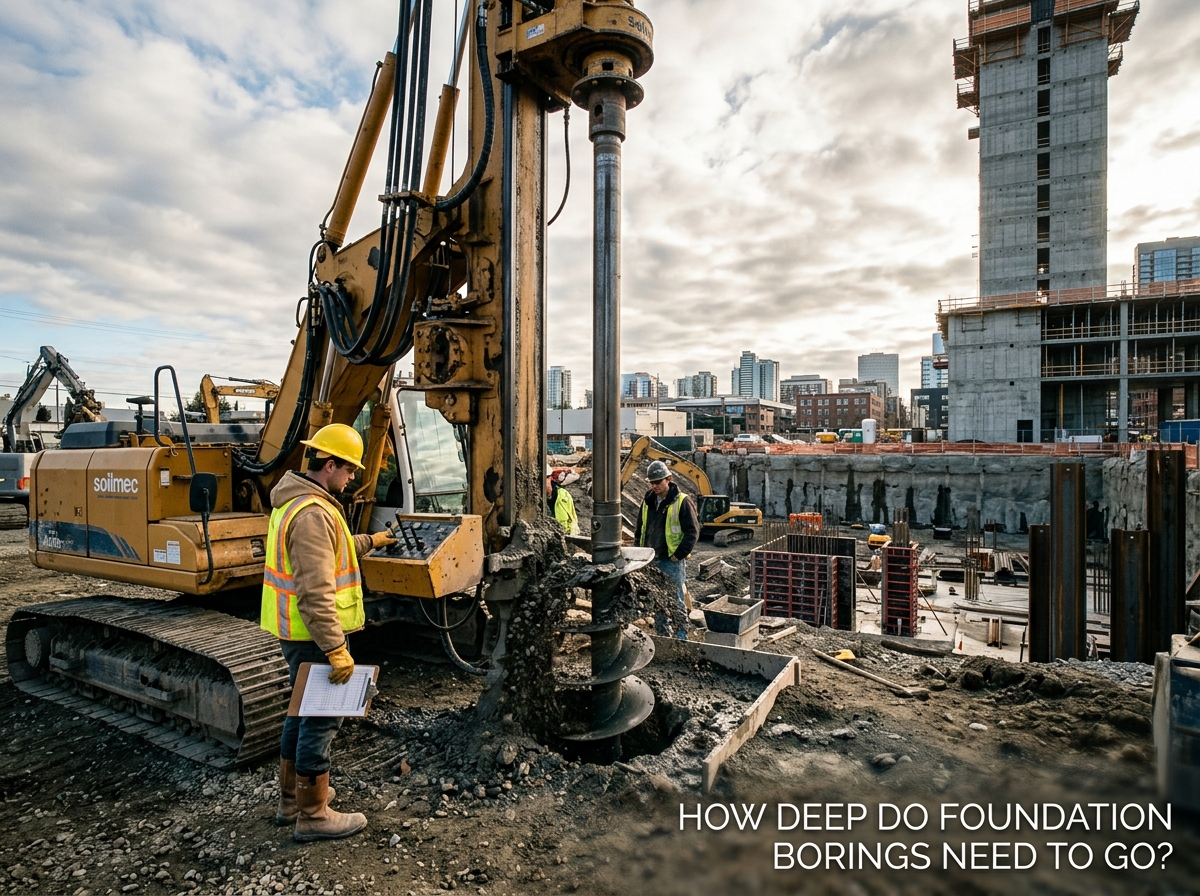
Foundation boring depth typically ranges from 1.5 times the footing width below the footing for shallow foundations, to 20–100+ feet for deep foundations bearing on bedrock. According to ASTM standards (2023), the exact depth of exploration depends on soil stratification, load-bearing capacity, and groundwater table conditions.
Before You Begin: Prerequisites

- Site plan and structural loads: Obtain preliminary loads from the structural engineer.
- Foundation type decision: Confirm shallow foundation, mat foundation, or deep foundation (pile foundation) intent.
- Access for drilling rig: Verify equipment access and utility clearance.
- Applicable code set: Identify local adoption of the International Building Code (IBC) and relevant ASTM standards.
- Budget for subsurface exploration: Allocate funds for soil test borings, rock coring, and lab testing.
- Licensed professional: Retain a geotechnical engineer or site geologist to supervise the geotechnical site investigation.
Step 1: Identify Foundation Type and Preliminary Loads

Determine whether the structure will use a shallow foundation (spread footing, mat foundation) or a deep foundation (pile foundation, drilled shaft). This decision drives foundation depth requirements before any drilling begins.
Sub-step: Estimate Anticipated Column and Wall Loads
Provide the geotechnical engineer with preliminary structural load analysis data so bearing capacity calculation assumptions align with actual design loads.
Step 2: Review IBC and ASTM Boring Depth Standards
IBC code requirements for geotechnical boring depth reference ASTM D1452, D1586, and D3550 for soil boring and sampling procedures. Unlike prescriptive footing tables, IBC Section 1803 requires site-specific subsurface investigation depth for structures beyond simple one- and two-family dwellings.
Sub-step: Confirm Local Amendments
Check whether your jurisdiction has amended standard boring depth guidelines, since some coastal and seismic zones mandate deeper exploration.
Step 3: Apply Minimum Boring Depth Rules by Foundation Type
Use the table below as a starting point for minimum boring depth, then adjust per Step 4.
| Foundation Type | Typical Minimum Boring Depth | Notes |
|---|---|---|
| Spread footing (residential) | 10–15 ft below footing | How deep should foundation borings be for a house: generally 1.5x footing width, minimum 10 ft |
| Two-story residential | 15–20 ft | How deep should soil borings be for a two story house: increases with added load |
| Mat foundation | 1–1.5x mat width | Depth of borings required for shallow foundations with wide loaded areas |
| Pile foundation | 10–20 ft below anticipated pile tip | Depth of borings required for deep pile foundations depends on bedrock depth |
| Commercial low-rise | 20–30 ft | Minimum depth for geotechnical borings on commercial sites |
| High-rise building | 50–100+ ft or to bedrock | Geotechnical boring depth requirements for high rise buildings scale with tower height |
| Bridge foundation | Varies to competent bearing stratum | How deep do soil borings need to go for bridge foundations: often 1.5x pile group width below tip |
For residential construction, how many feet deep should soil borings go depends on soil density testing results and depth to competent soil layers.
Step 4: Adjust Depth for Site-Specific Factors
Factors that affect foundation boring depth decisions include groundwater table elevation, depth of overburden, and proximity to bedrock.
Sub-step: Check Groundwater Table
Record groundwater table depth at time of drilling; a shallow water table can affect settlement analysis and require deeper exploration to characterize subsurface soil conditions.
Sub-step: Map Soil Stratification
Soil profile analysis identifies weak layers, fill, or organic soils that may push borings deeper than code minimums. A qualified foundation boring depth assessment accounts for these variable strata rather than relying solely on rule-of-thumb tables.
Sub-step: Locate Bedrock
If bedrock is shallow, rock coring 5–10 feet into bedrock confirms rock quality designation (RQD) and load-bearing capacity for pile foundation or drilled shaft design.
Step 5: Apply Boring Termination Criteria
Boring termination criteria define when drilling can stop. Common criteria include:
- Standard Penetration Test (SPT) blow count exceeding 50 blows per 6 inches for three consecutive intervals.
- Rock coring recovery showing RQD greater than 75% over 10 feet.
- Reaching depth to competent soil confirmed by two consecutive borings.
- Depth of exploration exceeding 1.5 times the structure’s least dimension, per ASTM standard requirements for boring depth in foundations.
Step 6: Select Testing Method and Sampling Intervals
Choose between Standard Penetration Test (SPT) and Cone Penetration Test (CPT) based on soil type and project needs.
Sub-step: Standard Penetration Test (SPT)
SPT provides standard penetration test results and disturbed samples classified under the Unified Soil Classification System every 2.5 to 5 feet, or at every stratum change.
Sub-step: Cone Penetration Test (CPT)
CPT delivers continuous soil density testing and soil consolidation testing data without physical samples, useful for rapid soil profile analysis in soft clays and sands.
Sub-step: Determine Sampling Depth and Spacing
Soil sampling depth intervals and boring spacing requirements should follow geotechnical exploration standards — typically one boring per 2,500–5,000 sq ft for commercial sites, or minimum two borings for small residential lots.
Step 7: Document Findings in Boring Log and Geotechnical Investigation Report
Every soil boring produces a boring log recording sample depth, SPT blow counts, groundwater table depth, and visual soil classification. Boring log interpretation supports the final geotechnical investigation report.
Sub-step: Summarize Bearing Capacity Calculation
The foundation engineer uses boring log data to complete bearing capacity calculation and settlement analysis, finalizing foundation design criteria for the structural engineer.
Sub-step: Cross-Check with Test Pits
For shallow investigations, test pit depth data can supplement soil test borings, especially where fill or debris is suspected near the surface.
Special Case: How to Determine Proper Boring Depth for Mat Foundations
Mat foundations distribute load over a large footprint, so borings should extend to a depth equal to the mat’s width or 1.5 times the width, whichever governs settlement analysis. This differs from isolated spread footings, where influence depth is limited to the individual footing zone.
Troubleshooting Common Boring Depth Issues
- If SPT refusal occurs above expected bedrock → perform rock coring to confirm true bedrock versus a boulder or cemented layer.
- If groundwater table rises unexpectedly during drilling → re-evaluate settlement analysis and consider deeper borings to assess liquefaction potential.
- If adjacent borings show inconsistent soil stratification → add supplemental borings to improve geotechnical site assessment accuracy.
- If budget limits boring count → prioritize borings at highest-load column locations per structural load analysis.
- If local code conflicts with ASTM minimum → apply the more conservative (deeper) boring depth standard.
Next Steps
After completing subsurface exploration, submit the geotechnical investigation report to your structural engineer for foundation design finalization. Schedule a follow-up geotechnical site investigation if excavation reveals conditions differing from the original soil boring data. For ongoing projects, maintain updated boring logs to support future additions or renovations requiring revised foundation bearing depth calculations.