Retaining Walls vs. Slope Stabilization: Which Solution Does Your Property Need? 2025
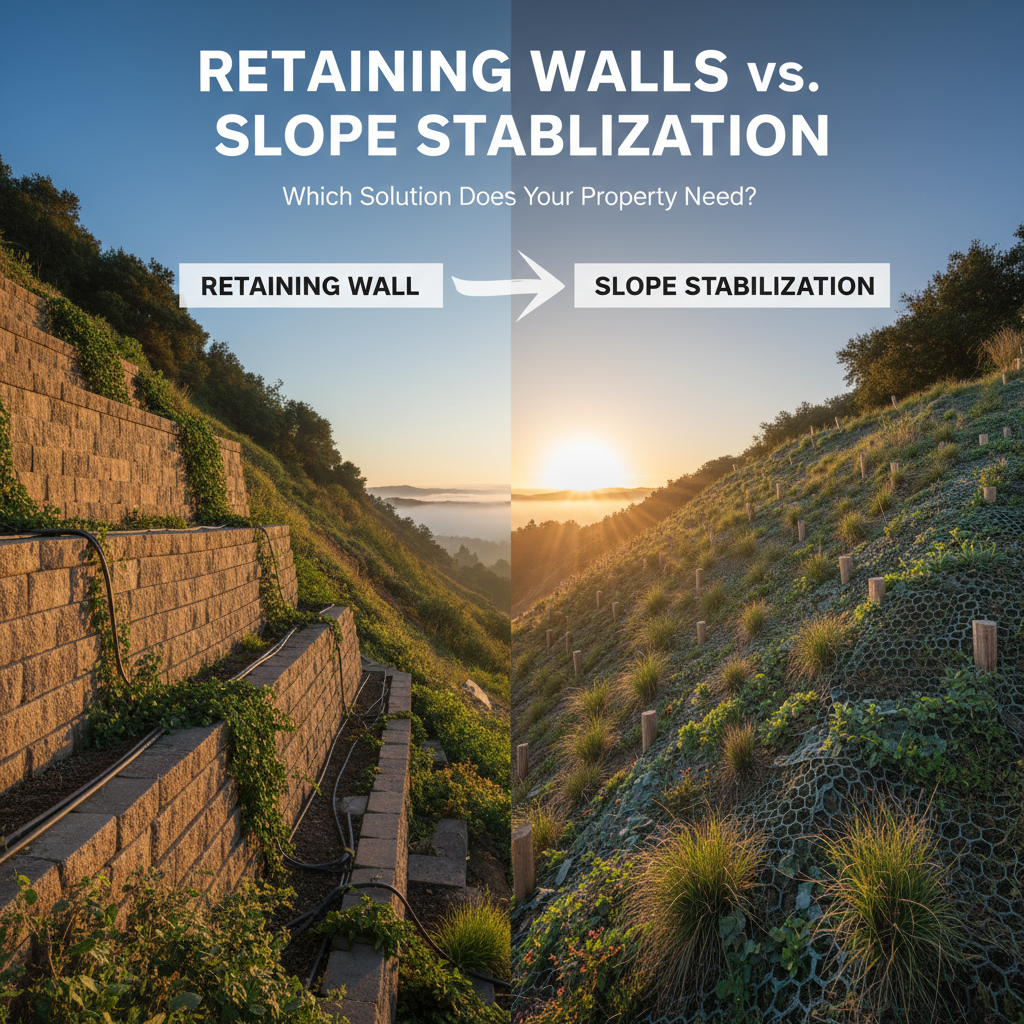
Retaining walls are permanent structural support systems that hold back soil through engineered earth retention, whereas slope stabilization uses reinforcement techniques to strengthen existing terrain without major construction. The choice between retaining walls and slope stabilization depends on slope angle (retaining walls for gradients exceeding 45 degrees), available space, budget constraints, and whether you need usable land expansion or simple erosion control. Properties with severe grade change management requirements typically require retaining walls, while gentle slopes benefit from natural slope modification techniques.
Retaining Walls vs. Slope Stabilization: Feature Comparison

| Feature | Retaining Walls | Slope Stabilization |
|---|---|---|
| Primary Function | Structural soil support and vertical grade transition | Soil movement prevention and erosion prevention methods |
| Slope Angle Application | Gradients 45-90 degrees requiring lateral support systems | Gradients 15-45 degrees suitable for ground reinforcement |
| Construction Complexity | Engineered walls requiring structural engineer or geotechnical engineer approval | Moderate to simple installation of geogrid, vegetation stabilization, or soil nailing |
| Average Cost (2025) | $25-150 per square foot for concrete blocks, reinforced concrete, or natural stone | $5-35 per square foot for riprap, geotextile, or root systems installation |
| Lifespan | 50-100 years for masonry walls and segmental retaining walls | 20-50 years depending on vegetation stabilization maturity and soil reinforcement |
| Maintenance Requirements | Drainage system inspection annually, weep holes clearing, structural monitoring | Vegetation maintenance, erosion inspection, subsurface water monitoring |
| Space Requirements | Requires excavation, backfill material, and aggregate base installation | Works within existing terrain with minimal contour grading |
| Permit Requirements | Required for walls exceeding 3-4 feet height in most jurisdictions | Typically minimal permitting for vegetation or geogrid slope stabilization |
What Are Retaining Walls and When Are They Necessary?

Retaining walls are engineered earth retaining structures designed to resist lateral earth pressure from soil at different elevations. According to the American Society of Civil Engineers (2024), retaining walls become structurally necessary when slope angles exceed 45 degrees or when creating usable land expansion on hillside property requires significant terrain modification.
Types of Retaining Wall Construction
Gravity walls rely on mass to resist active pressure from retained soil. These freestanding walls constructed from concrete blocks, natural stone, or masonry walls typically serve properties with moderate height requirements under 4 feet. The bearing capacity of foundation soil determines maximum safe height.
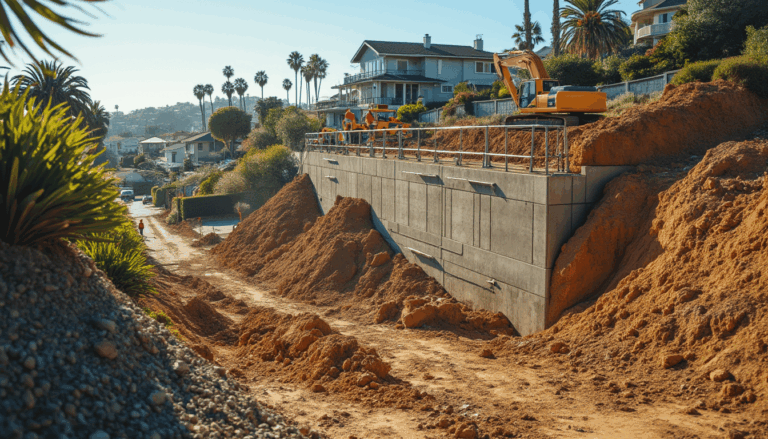
Cantilever walls utilize reinforced concrete with steel reinforcement creating an L-shaped profile. The horizontal base extends beneath backfill material, using soil weight to counteract lateral forces. Engineered walls of this type commonly support heights from 8-25 feet on hillside construction projects.
Anchored walls incorporate tie-backs or ground anchors extending into stable soil behind the wall face. This anchored systems approach allows taller structures with reduced wall thickness compared to gravity walls, making them cost-effective for commercial retaining wall applications.
Segmental retaining walls use interlocking walls of modular blocks with geogrid reinforcement layers. These engineered slope solutions provide flexibility for curved walls and stepped walls while accommodating minor ground movement without structural failure.
Critical Components of Wall Construction
Every retaining wall requires proper drainage installation to prevent hydraulic erosion and hydrostatic pressure buildup. A French drain with perforated pipe collects subsurface water, while weep holes at 4-6 foot intervals allow moisture barrier function. According to geotechnical engineers (National Concrete Masonry Association, 2024), inadequate groundwater management causes 60% of retaining wall failures within 10 years.
What Is Slope Stabilization and How Does It Work?
Slope stabilization encompasses ground stabilization techniques that strengthen existing terrain through soil reinforcement, vegetation, or mechanical anchoring systems. Unlike barrier walls that create abrupt vertical transitions, gradient stabilization preserves natural topography while preventing slope failure and landslide prevention.
Natural Slope Stabilization Methods
Vegetation stabilization utilizes deep root systems to bind soil particles and reduce surface runoff velocity. Native grasses, shrubs, and trees create biological reinforcement that improves soil compaction over 3-5 years. Research from the Soil Science Society of America (2023) demonstrates that established root systems reduce soil movement by 70-85% on slopes under 35 degrees.
Riprap installation places large stones along embankment support areas to dissipate water energy and prevent hydraulic erosion. This hillside erosion prevention technique proves effective for cut slope protection along driveways and drainage channels where water concentration occurs.
Engineered Slope Reinforcement Methods
Soil nailing involves driving steel bars into slope faces at 15-degree angles, creating internal tension members. Grouted anchors develop pullout resistance within native soil, transforming unstable material into coherent mass. Soil nailing systems handle slopes from 45-70 degrees at 40-60% less cost than equivalent concrete walls.
Geogrid and geotextile installation layers synthetic reinforcement during fill slope support construction. These polymeric grids distribute loads across wider areas, increasing effective soil strength. When combined with proper soil compaction, geogrid slope stabilization supports residential slope stabilization for gradients up to 50 degrees.
Micropiles provide deep foundation protection on hillside property with unstable subsurface conditions. These small-diameter drilled piles transfer loads to competent bearing strata, preventing downslope soil movement. For specialized ground improvement applications requiring advanced equipment, professional services like Unlimited Drilling offer expertise in micropile installation and subsurface stabilization.
How Do Costs Compare Between Retaining Walls and Slope Stabilization?
The cost comparison retaining walls vs slope stabilization reveals significant differences based on project scope and material selection. According to HomeAdvisor (2025), residential retaining wall installation averages $25-150 per square foot depending on wall type:
- Timber walls: $25-45 per square foot (15-25 year lifespan)
- Concrete block retaining wall: $40-70 per square foot (50-75 year lifespan)
- Poured walls (reinforced concrete): $60-90 per square foot (75-100 year lifespan)
- Natural stone retaining wall: $80-150 per square foot (100+ year lifespan)
In contrast, slope stabilization methods cost $5-35 per square foot:
- Vegetation stabilization: $5-12 per square foot (ongoing maintenance required)
- Erosion control retaining wall alternatives (riprap): $10-25 per square foot
- Geogrid installation with revegetation: $15-30 per square foot
- Soil nailing for steep slopes: $25-45 per square foot (specialized equipment required)
Hidden costs significantly impact total project expenses. Retaining wall permit requirements add $500-2,000 in engineering fees for stamped plans. Excavation and aggregate base preparation increase costs by 30-40% on sites with poor soil conditions. Drainage solutions including French drains add $15-30 per linear foot.
When Should You Choose Retaining Walls Over Slope Stabilization?
Use Case 1: Creating Usable Outdoor Space on Steep Property
Scenario: A hillside property has a 60-degree slope reducing usable backyard area by 70%. The homeowner needs flat space for a patio and landscaping structural support.
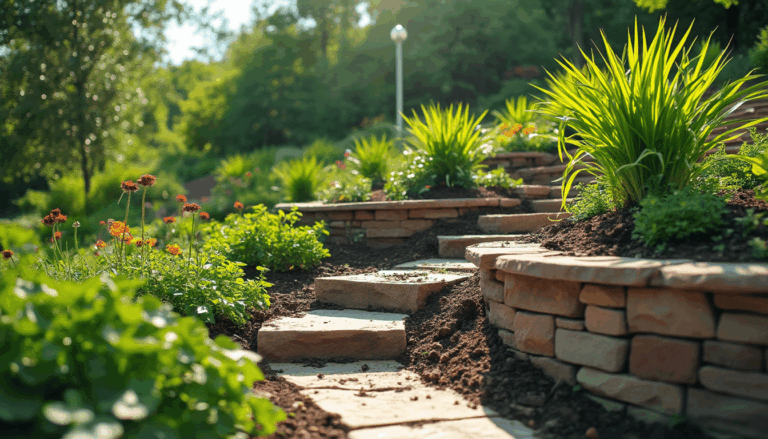
Solution: Tiered retaining walls for steep slopes create multiple level terraces. A landscape architect designs segmental retaining wall systems with proper drainage behind retaining wall installations. This terracing vs retaining walls approach transforms unusable incline into functional outdoor space creation zones.
Why retaining walls win: Slope stabilization cannot create horizontal surfaces. Only structural walls achieve vertical grade transition necessary for property elevation control on severe gradients.
Use Case 2: Foundation Protection Against Active Soil Pressure
Scenario: A basement foundation experiences lateral movement from adjacent hillside exerting passive pressure. Cracks appear in foundation walls during wet seasons when groundwater management fails.
Solution: An engineered retaining wall for slope support installed 6-8 feet from the foundation intercepts lateral forces. The structural engineer specifies anchored walls with tie-backs extending 15 feet into stable soil, achieving required factor of safety of 1.5 against overturning.
Why retaining walls win: Foundation protection demands predictable load resistance. Retaining walls provide engineered lateral support systems with calculable performance, whereas vegetative slope stabilization offers variable, unquantified support.
When Should You Choose Slope Stabilization Over Retaining Walls?
Use Case 3: Preventing Erosion on Moderate Garden Slopes
Scenario: A sloped yard with 25-degree gradient experiences surface runoff erosion creating ruts and exposing root systems. The property owner needs best solution for hillside erosion control that preserves natural aesthetics.
Solution: Vegetative slope stabilization combining native grasses, groundcover, and shrub installation. A landscape architect adds contour grading to create shallow swales directing water, supplemented by biodegradable erosion control blankets during establishment.
Why slope stabilization wins: Natural slope modification costs 75% less than wall construction while enhancing property aesthetics. For gradients under 35 degrees without space constraints, vegetation provides adequate soil stability improvement.
Use Case 4: Stabilizing Large Embankments Cost-Effectively
Scenario: A commercial property has a 150-foot-long, 35-degree embankment along an access road requiring embankment stabilization. Budget constraints limit spending to $25,000.
Solution: Geogrid slope stabilization installation during regrading, followed by hydroseeding with deep-rooted native species. Riprap placement at drainage concentration points prevents hydraulic erosion. Total cost: $22 per square foot versus $60+ per square foot for equivalent segmental walls.
Why slope stabilization wins: For extensive areas with moderate gradients, ground reinforcement techniques provide 60-70% cost savings. The site grading techniques preserve existing drainage patterns without complex drainage installation.
How to Decide Between Retaining Walls and Slope Stabilization
Choose retaining walls if:
- Slope angle exceeds 45 degrees requiring structural earth pressure resistance
- You need usable land expansion creating flat terraced areas
- Property grade management must address lateral earth pressure against structures
- Local codes mandate engineered walls for slopes exceeding maximum slope angle without retaining wall
- Site constraints prevent adequate space for gradient control through grading
- Permanent, low-maintenance earth retention systems justify higher initial investment
Choose slope stabilization if:
- Slope angle ranges from 15-40 degrees suitable for soil strengthening methods
- Budget prioritizes cost-effective hillside property protection over space creation
- Natural aesthetics and landscape integration outweigh need for vertical transitions
- Erosion repair and soil stabilization address primary concerns versus structural support
- Time allows 2-4 year vegetation establishment for long-term ground stabilization
- Temporary slope stabilization solutions suffice before permanent improvements
When Do You Need Professional Engineering Assessment?
A geotechnical engineer evaluation becomes mandatory when slopes exhibit signs of instability including progressive cracking, leaning trees, or seasonal movement. According to the International Code Council (2024), retaining wall requirements for sloped property include professional design for walls exceeding 4 feet height or supporting surcharges from structures, driveways, or pools.
Professional assessment determines soil mechanics properties including shear strength, bearing capacity, and groundwater conditions. A structural engineer calculates required embedment depth, reinforcement specifications, and drainage system capacity ensuring the factor of safety meets or exceeds 1.5 for permanent installations.
For slopes showing retaining wall failure signs including tilting, cracking, or bulging, immediate professional evaluation prevents catastrophic collapse. How to fix failing slope without retaining wall scenarios may involve emergency soil nailing, temporary ground anchors, or strategic drainage improvements pending permanent repairs.
Combining Retaining Walls and Slope Stabilization for Optimal Results
Many successful hillside landscaping solutions integrate both approaches. A common strategy uses stepped retaining walls creating 3-4 foot vertical transitions between terraces, with vegetative slope stabilization on resulting benches. This hybrid approach reduces total wall height requirements by 40-50% while maintaining usable yard leveling alternatives.
For steep slope management exceeding 55 degrees, gabion walls filled with stone provide structural earth support while allowing vegetation growth through voids. The gabion wall vs traditional retaining wall slope comparison favors gabions for sites requiring both erosion control and structural capacity, combining benefits of both systems.
Water management systems prove critical regardless of solution choice. Surface runoff directed away from wall faces through contour grading prevents saturation. Subsurface water collection via French drains with perforated pipe reduces hydrostatic pressure. Proper water diversion extends system lifespan by 30-50 years according to drainage specialists.