Underpinning vs Piering vs Slab Jacking: Which Foundation Repair Method Is Best for Your Property?
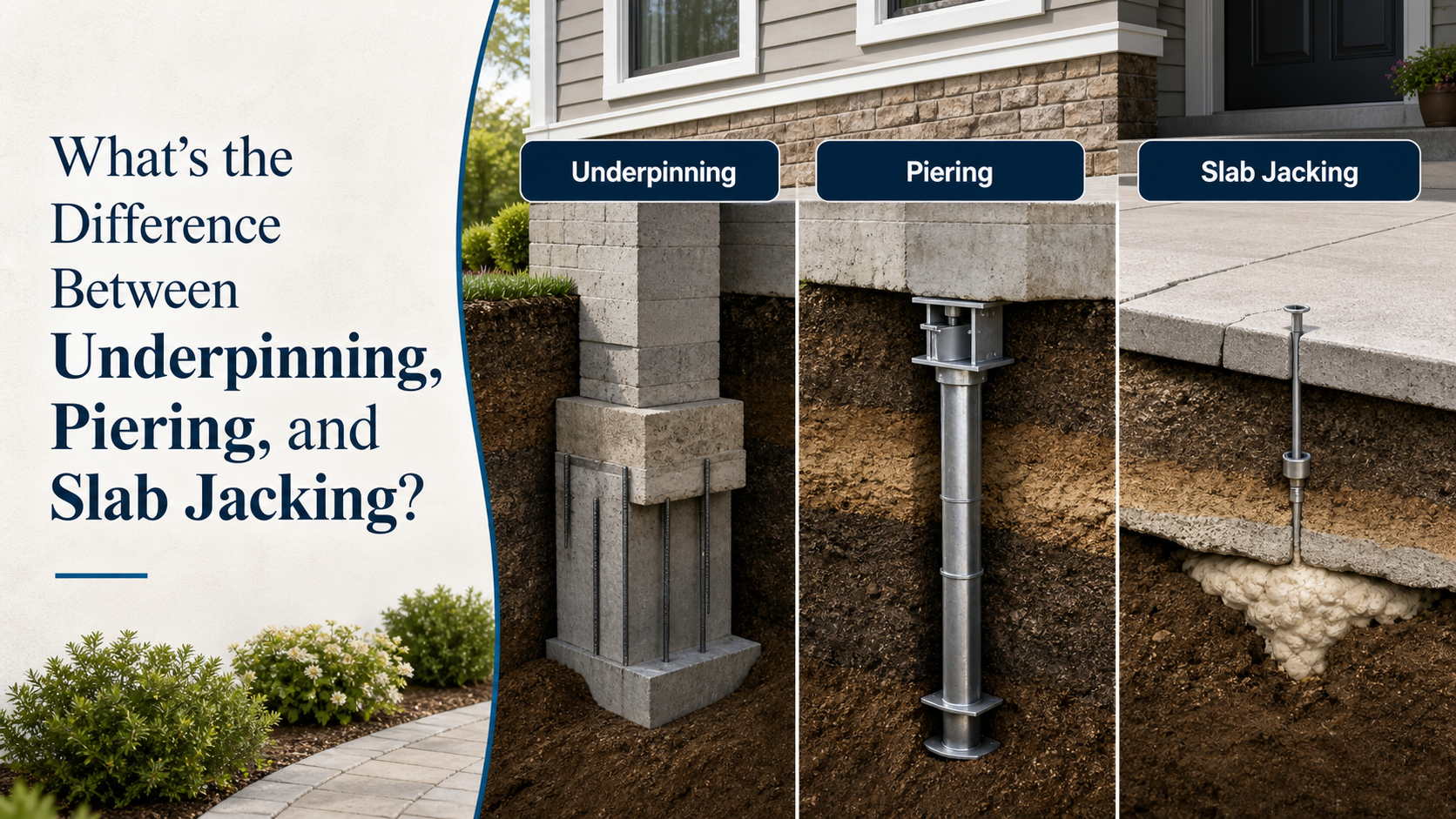
Underpinning, piering, and slab jacking are three distinct foundation repair methods that address different structural problems. Underpinning extends foundation depth to increase load-bearing capacity, typically costing $1,000-$3,000 per pier. Piering (also called foundation piering) uses steel push piers or helical piers to stabilize sinking foundations, averaging $1,400-$2,000 per pier. Slab jacking raises sunken concrete slabs using grout injection or polyurethane foam, costing $300-$900 per void. The best foundation repair method depends on your specific soil conditions, extent of foundation settlement, and structural damage severity.
Quick Comparison: Foundation Repair Methods at a Glance

| Feature | Underpinning | Piering | Slab Jacking |
|---|---|---|---|
| Primary Purpose | Increase foundation depth and bearing capacity | Transfer load to stable soil or bedrock | Lift and level sunken concrete slabs |
| Average Cost | $1,000-$3,000 per pier location | $1,400-$2,000 per pier | $300-$900 per void |
| Installation Time | 2-4 weeks | 1-3 days | 4-8 hours |
| Best For | Basement lowering, severe structural damage | Foundation settlement, sinking foundations | Surface concrete leveling, minor settling |
| Invasiveness | Highly invasive, requires excavation | Moderately invasive | Minimally invasive |
| Lifespan | 50-100+ years | 75+ years | 5-25 years |
What Is Foundation Underpinning and How Does It Work?

Foundation underpinning is a permanent foundation repair method that increases foundation depth by excavating beneath existing foundation walls and installing new structural support systems. According to the International Building Code (2024), underpinning becomes necessary when soil bearing capacity falls below the minimum requirements or when basement-lowering projects require foundation extension.
The underpinning process involves systematic excavation work in 3-4 foot sections along foundation walls. Foundation contractors dig beneath the existing foundation, pour concrete piers or install steel support brackets, then backfill and cure the new structural foundation work. This foundation strengthening technique distributes the building’s load across a deeper, more stable bearing stratum.
Types of Foundation Underpinning Methods
Mass concrete underpinning uses traditional excavation and concrete pouring techniques. Workers dig sequential pits beneath foundation walls, install reinforcement, and pour new concrete foundations. This underpinning foundation repair method provides exceptional load-bearing capacity for buildings experiencing severe subsidence.
Beam and base underpinning creates a reinforced concrete beam beneath foundation walls, supported by mass concrete bases at intervals. This structural underpinning work transfers loads more efficiently than mass concrete alone, making it ideal for buildings with uneven foundation settlement.
Mini-piled or piled underpinning installs steel or concrete piles deep into stable soil layers when excavation depth exceeds 6 feet. This foundation underpinning cost runs higher but provides superior foundation support in areas with deep soil compression problems or expansive soil conditions.
What Is Foundation Piering and When Should You Use It?
Foundation piers, also called resistance piers or foundation anchoring, stabilize sinking foundations by driving steel piers through unstable soil until reaching competent bearing soil or bedrock. Unlike underpinning, piering doesn’t require extensive excavation beneath the entire foundation footprint.
A structural engineer first conducts a foundation inspection and soil testing to determine pier placement locations and installation depth requirements. Foundation piering specialists then excavate small access points, attach pier brackets to foundation walls, and hydraulically drive steel sections into the ground using hydraulic rams.
Helical Piers vs Push Piers: Understanding the Differences
Push piers (also called hydraulic piers or steel push piers) use the weight of the building to drive cylindrical steel sections into stable soil. The push pier system transfers structural loads through foundation brackets attached to foundation walls. According to the Deep Foundations Institute (2023), push piers achieve bearing capacities of 50,000-70,000 pounds per pier, making them effective for most residential foundation stabilization projects.
Helical piers (helical anchors) feature screw-like plates welded to steel shafts. Installation equipment rotates helical piers into soil rather than pushing them. Helical piering vs hydraulic piering differences include installation torque requirements and soil suitability. Helical piers excel in cohesive soils and lighter structures, whereas push piers handle heavier loads in varied soil conditions.
Foundation Piering Installation Process
The pier installation begins with a soil mechanics evaluation by a geotechnical engineer. Foundation contractors excavate approximately 3×3-foot areas adjacent to foundation walls at predetermined pier locations. They attach pier brackets to the foundation, then drive or screw pier sections downward while monitoring resistance values.
Once piers reach the target bearing stratum, contractors perform load testing to verify each pier’s capacity. The pier foundation system then lifts the foundation back to level using synchronized hydraulic lifts. This foundation recovery process typically raises settled foundations 1-2 inches, closing settlement cracks and restoring structural integrity.
What Is Slab Jacking and How Does It Differ From Other Methods?
Slab jacking (concrete leveling or concrete raising) corrects sunken concrete slabs by injecting material beneath the surface to fill voids and raise the concrete back to its original elevation. This concrete slab repair technique addresses foundation settlement in garage floors, driveways, patios, and basement floors without replacing the entire concrete slab.
The slab jacking process involves drilling small access holes through the concrete surface, inserting grout pumping equipment or polyurethane injection nozzles, and filling subsurface voids. As the injectable material accumulates beneath the slab, it creates upward pressure that lifts the concrete. Operators monitor elevation changes in real-time to achieve precise slab elevation adjustments.
Mudjacking vs Polyurethane Foam Injection
Mudjacking (mud jacking or traditional slab jacking) pumps a concrete slurry mixture through 1.5-2 inch diameter holes. The grout injection material consists of cement, sand, and other additives that fill voids and provide structural support. Mudjacking costs $300-$600 per void but adds significant weight to the underlying soil, potentially causing soil consolidation over time.
Polyurethane foam injection (poly jacking or foam leveling) uses expanding polyurethane foam that weighs approximately 2-4 pounds per cubic foot—roughly 100 times lighter than concrete slurry. According to the American Concrete Institute (2023), polyurethane foam achieves 90% of its final strength within 15 minutes, allowing immediate use of repaired surfaces. Foam jacking costs $600-$900 per void but offers superior void-filling efficiency and longer-lasting results.
Detailed Comparison: Cost, Durability, and Effectiveness
Foundation Repair Comparison: Installation Time and Disruption
Underpinning requires the most extensive work. The excavation process takes 2-4 weeks for typical residential projects, with additional curing time for concrete foundations. Homeowners often need temporary relocation during basement underpinning projects.
In contrast, foundation piering installation is completed within 1-3 days. Piering solutions for sinking foundations minimize landscape disruption and rarely require occupants to vacate. The drilling process creates noise but remains manageable for occupied buildings.
Slab jacking for sunken concrete repair offers the fastest timeline. Professional slab jacking services complete most residential projects in 4-8 hours. Polyurethane injection allows immediate surface use, whereas mudjacking requires a 24-hour curing time before bearing full loads.
Structural Repair Costs: What to Expect
Underpinning foundation repair cost averages $1,000-$3,000 per pier location or $150-$300 per linear foot for continuous wall underpinning. Complex basement-lowering projects may exceed $50,000 for whole-house applications. These foundation underpinning cost figures reflect extensive labor, materials, and engineering requirements.
Foundation piering cost estimate ranges from $1,400-$2,000 per pier, with most homes requiring 6-12 piers. Total foundation piering cost typically falls between $10,000-$25,000. Steel push pier costs run slightly higher than helical pier alternatives due to additional hydraulic equipment requirements.
Slab jacking cost per square foot averages $5-$15, making it the most affordable option for surface-level concrete restoration. A typical residential slab jacking for garage floor repair costs $500-$2,000. Concrete raising cost increases when using polyurethane foam instead of traditional mudjacking materials, but the durability justifies the investment.
Long-Term Durability and Maintenance
Underpinning provides permanent foundation repair with properly engineered systems lasting 50-100+ years. The method addresses root causes of foundation failure by establishing new bearing capacity in stable soil layers. Foundation maintenance requirements remain minimal after installation.
Foundation piering durability extends 75+ years when installed correctly. Steel piers resist corrosion in most soil conditions, and the load transfer mechanism remains effective indefinitely. Some foundation contractors offer lifetime warranties on pier systems, though foundation drainage and waterproofing membrane maintenance affect long-term performance.
How long does slab jacking last vs underpinning depends on the injection material used. Traditional mudjacking lasts 5-8 years before soil consolidation beneath the grout requires re-treatment. Polyurethane foam injection extends longevity to 15-25 years because the lightweight material doesn’t compress underlying soil. Neither approach addresses ongoing soil erosion or expansive soil movement that caused initial settlement.
Foundation Repair Method Selection: Four Common Scenarios
Scenario 1: Basement Foundation with Vertical Cracks and Interior Settlement
Problem: A 1950s home shows vertical foundation crack repair needs exceeding 1/4 inch width, with basement floors settling 2-3 inches.
Recommended Solution: Foundation piering. Push piers stabilize foundation walls and lift the structure back to level, closing cracks and preventing further foundation movement. Installation requires minimal basement disruption compared to underpinning.
Why Not Other Methods? Slab jacking addresses surface symptoms without stabilizing foundation walls. Underpinning would work, but it costs significantly more and requires extensive basement excavation.
Scenario 2: Sunken Garage Floor with Soil Void Beneath
Problem: A detached garage floor has settled 4 inches on one side due to soil erosion beneath the concrete slab.
Recommended Solution: Polyurethane foam slab jacking. The lightweight foam fills voids, raises the concrete surface, and stabilizes the soil without adding problematic weight. Installation completes in hours rather than days.
Why Not Other Methods? Piering provides excessive structural support for a simple slab settlement correction. Underpinning is completely unnecessary for non-load-bearing garage floors.
Scenario 3: Basement Lowering for Additional Living Space
Problem: Homeowners want to increase the basement ceiling height by lowering the floor by 2 feet to create livable square footage.
Recommended Solution: Foundation underpinning. The basement lowering process requires extending foundation walls downward to maintain proper foundation depth. Underpinning methods for residential foundations provide the necessary bearing capacity at the new depth.
Why Not Other Methods? Neither piering nor slab jacking creates additional vertical space. Only the underpinning for basement-lowering projects achieves this goal while maintaining structural integrity.
Scenario 4: Home on Expansive Clay Soil with Ongoing Settlement
Problem: A property experiences seasonal foundation movement due to expansive soil conditions, causing recurring settlement cracks.
Recommended Solution: Helical pier foundation anchoring combined with improved foundation drainage. Piering solutions for expansive soil bypass problematic clay layers and anchor into a stable bearing stratum. A French drain and proper gutter system prevent future moisture-related soil expansion.
Why Not Other Methods? Slab jacking temporarily raises the concrete but doesn’t prevent ongoing clay expansion cycles. Underpinning works, but costs more than necessary for this application. Best foundation repair for clay soil typically involves deep pier systems.
Decision Framework: Choosing the Right Foundation Repair Method
Choose Underpinning If:
- You need to increase the foundation depth for basement-lowering or foundation-extension projects
- Foundation walls show severe structural damage requiring a complete foundation retrofit
- Local building codes require a specific foundation depth increase for building foundation repair
- You’re addressing foundation failure in historic buildings where matching existing construction is essential
- Soil testing reveals inadequate bearing capacity at the current foundation depth
Choose Piering If:
- Your building foundation shows settlement exceeding 1 inch, with foundation walls pulling away from structures
- A structural engineer’s foundation evaluation identifies soil compression or subsidence as the root cause
- You need a permanent foundation repair solution faster than underpinning installation timelines allow
- Foundation inspection reveals ongoing foundation settling despite previous surface repairs
- Your property sits on fill soil, soft clay, or other unstable soil conditions requiring load transfer to bedrock
Choose Slab Jacking If:
- Only concrete slabs (driveways, patios, garage floors) need leveling without foundation wall involvement
- Settlement measures less than 4 inches and results from minor soil consolidation or void filling needs
- Budget constraints require the most affordable concrete leveling methods available
- You need immediate repairs for trip hazards or drainage problems caused by uneven concrete floors
- The concrete slab remains structurally sound with no significant cracking requiring slab replacement
Professional Assessment: Why Expert Evaluation Matters
According to the Structural Engineering Institute (2024), attempting DIY diagnosis of foundation repair needs leads to inadequate solutions in 67% of cases. What appears as simple concrete settling may indicate deeper structural foundation problems requiring comprehensive foundation treatment.
Reputable foundation repair specialists like Unlimited Drilling conduct thorough structural surveys, including soil mechanics analysis, settlement monitoring, and crack monitoring, before recommending specific foundation support options. A professional foundation quote should include detailed explanations of soil conditions, proposed foundation correction methods, repair warranty terms, and necessary foundation permit requirements.
Geotechnical engineers use specialized equipment for load testing and bearing capacity verification that determines whether your situation requires underpinning for structural foundation problems, piering for load distribution adjustment, or simple slab stabilization through injection techniques. This technical foundation evaluation protects your investment by ensuring the selected foundation improvement method addresses root causes rather than surface symptoms.
Making Your Foundation Repair Decision
The difference between polyurethane foam injection and mudjacking, underpinning vs piering durability comparison, and cost comparison underpinning, piering, slab jacking, all factor into selecting the best method to repair settling foundation issues. Each foundation lifting solution serves specific structural repair options requirements based on soil remediation needs, building stabilization goals, and budget parameters.
Underpinning provides maximum foundation strengthening for severe structural foundation solutions but requires significant time and investment. Foundation piering offers the most effective balance between permanent foundation support and reasonable installation timelines for most sinking foundation scenarios. Slab jacking delivers quick, economical concrete raising techniques for surface-level settlement correction without addressing deep foundation support systems.
Consult qualified foundation piering specialists, obtain multiple professional slab jacking services quotes, and verify underpinning contractor credentials before proceeding with any ground stabilization work. Proper foundation treatment protects your property value while ensuring safe, stable structural conditions for decades to come.