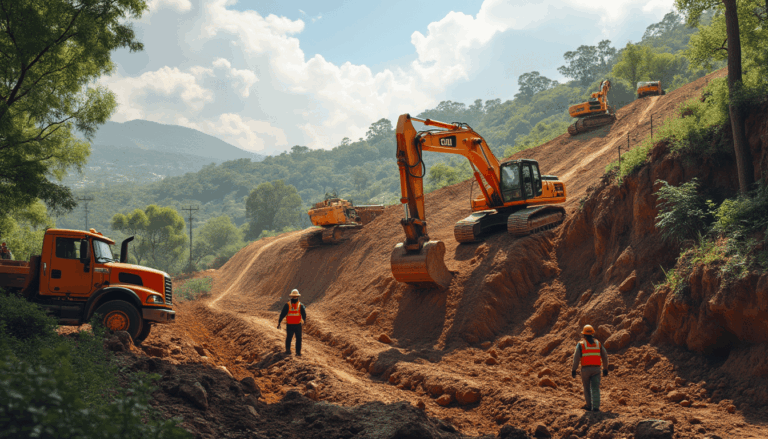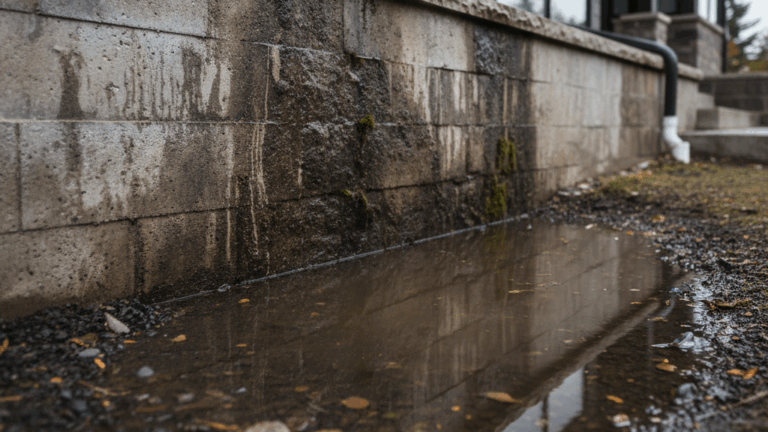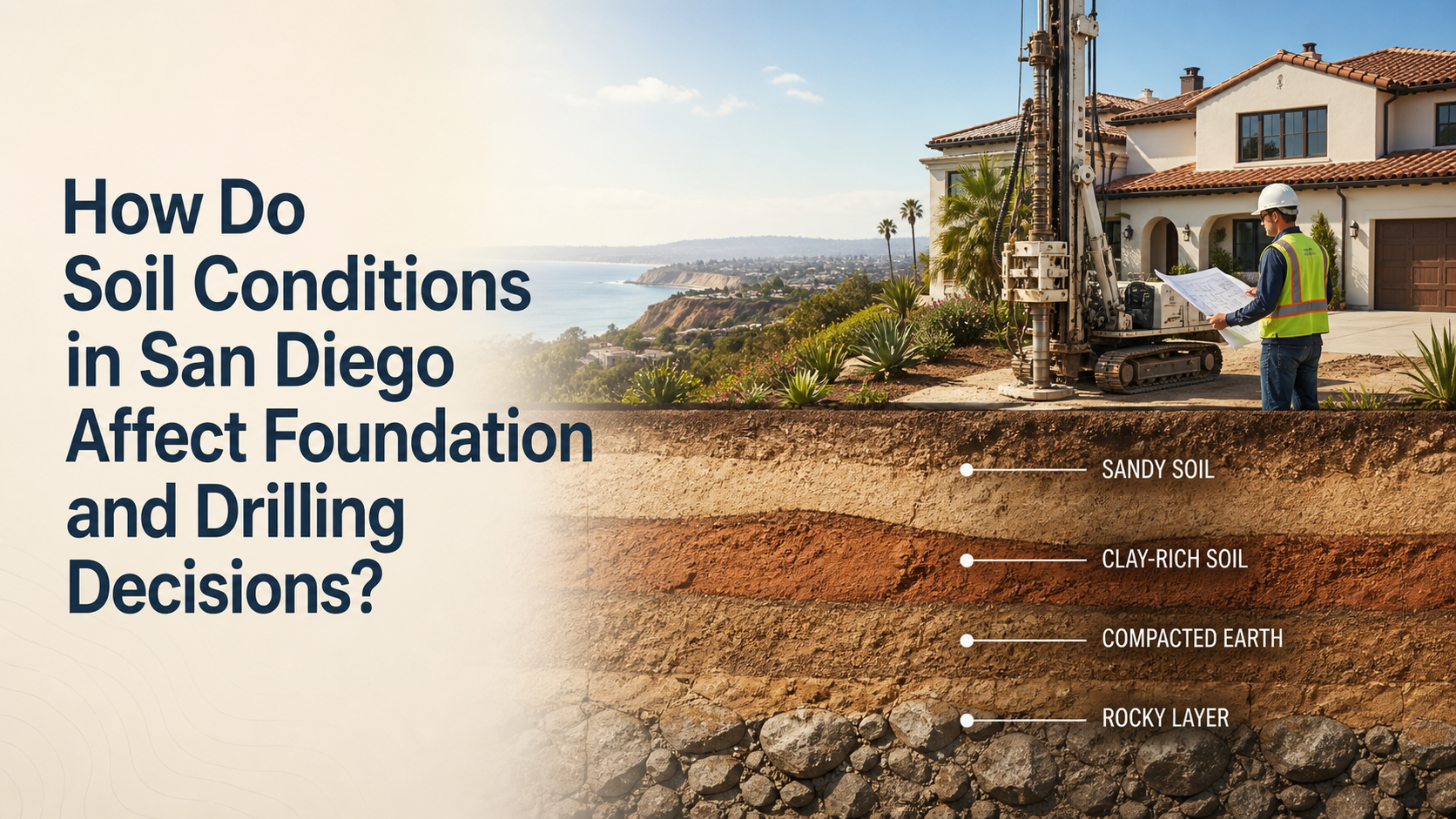
What Are San Diego Soil Conditions? How They Determine Foundation and Drilling Requirements
San Diego soil conditions refer to the subsurface characteristics and geological formation properties that determine how the ground supports structures and responds to drilling operations. These ground conditions California vary significantly across San Diego County, from expansive clay soil inland to marine sediment along the coast, directly influencing foundation design criteria and drilling methodology for all construction projects.
Understanding how San Diego soil affects foundations is critical for construction success. According to the California Geological Survey (2024), improper foundation type selection based on soil composition San Diego accounts for 68% of residential foundation failures in the region. The USGS reports that San Diego’s position on the Pacific Plate, combined with geological formations like the Rose Canyon Fault, creates unique subsurface conditions requiring site-specific soil testing before any construction begins.
Key Characteristics of San Diego Soil Conditions
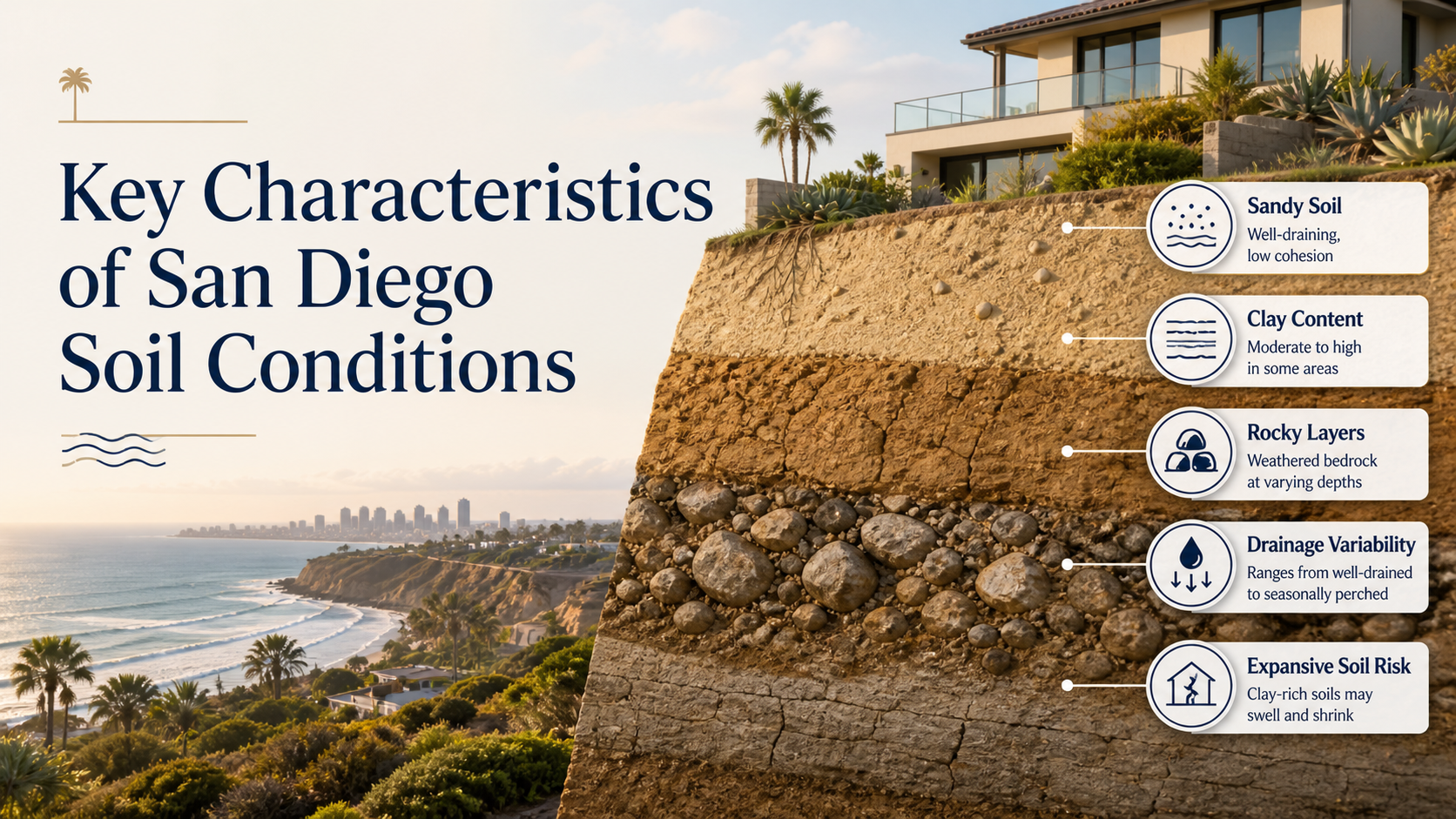 San Diego soil: Sandy loam, alkaline, dry, well-drained, low fertility.
San Diego County soil composition exhibits five distinct characteristics that affect foundation engineering and drilling operations:
1. Expansive Clay Content in Inland Regions
Adobe clay and expansive soil dominate areas including Mission Valley, Escondido, and inland Carlsbad. These soils contain high plasticity index values (typically 25-45 according to ASTM International standards) and expand up to 15% when moisture content analysis shows saturation. The Atterberg limits for San Diego expansive clays range from liquid limit 40-60 and plastic limit 20-30, creating significant foundation settlement prediction challenges.
2. Marine Sediment in Coastal Zones
The Coastal Zone from Oceanside through Del Mar to Point Loma contains sandy soil and marine sediment from ancient ocean deposits. The Point Loma Formation and Torrey Sandstone provide relatively stable foundation performance with California bearing ratio values of 8-15. These coastal soil properties typically show well-graded soil composition with friction angle measurements of 32-38 degrees.
3. Geological Stratification Complexity
Soil stratification in San Diego includes multiple layers: the Lindavista Formation (terrace deposits), Santiago Formation (sedimentary rock), Friars Formation (sandstone and siltstone), and Stadium Conglomerate. A geotechnical investigation by a qualified geotechnical engineer typically reveals 3-7 distinct soil profile layers within the first 30 feet of excavation depth.
4. Caliche and Hard Pan Layers
Caliche, a calcified soil layer, appears 2-8 feet below surface across eastern San Diego County. This drilling obstruction requires specialized drilling equipment selection and affects drilling speed, often reducing penetration rates by 60-80% compared to drilling through soft clay soil or sandy soil.
5. Variable Groundwater Table Elevation
The water table elevation fluctuates from 5 feet below surface in valley soil conditions to 40+ feet in hillside soil stability zones. Perched water tables occur frequently in La Jolla and Chula Vista, complicating foundation depth requirements and requiring moisture barrier installation for clay soil protection.
How San Diego Soil Conditions Affect Foundation Design Decisions
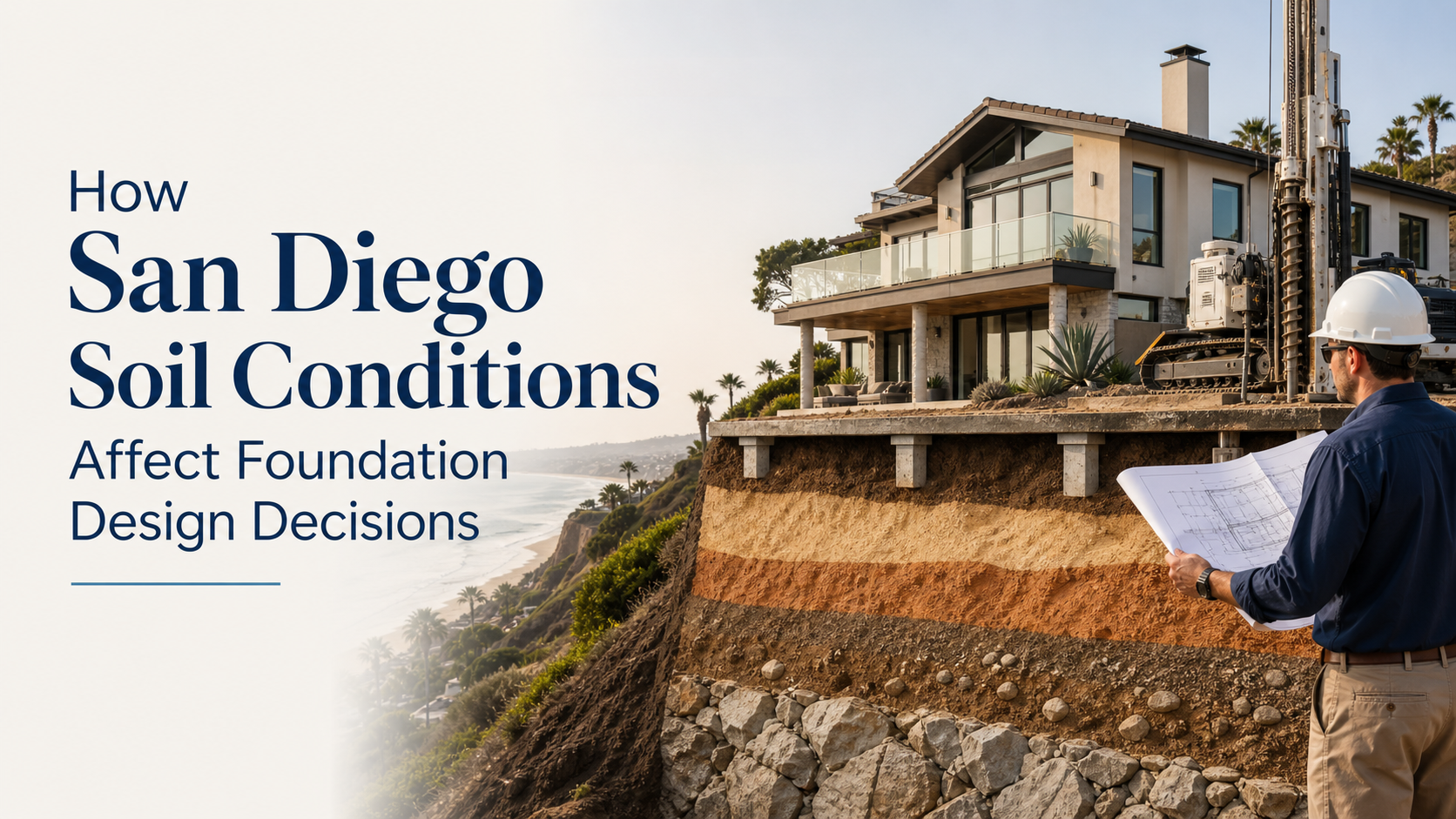 San Diego soil, foundation design, construction, engineering, soil conditions, building.
Foundation Type Selection Process
Civil engineers and structural engineers select foundation systems based on soil bearing capacity values determined through subsurface conditions analysis. Standard Penetration Test (SPT) results guide foundation type selection:
- Slab-on-grade foundations: Suitable for bearing capacity values exceeding 2,000 pounds per square foot (psf), common in coastal sandy soil areas with low soil compressibility
- Post-tensioned slab foundations for San Diego expansive soil: Required when plasticity index exceeds 20 and clay content percentage reaches 30-50%, typical in Mission Valley soil conditions
- Pier and beam vs slab foundation San Diego soil: Pier systems penetrate 8-15 feet through expansive clay to reach stable bearing strata, preventing differential settlement San Diego foundations
- Drilled pier foundation design for San Diego bedrock: Extended 3-5 feet into bedrock when encountered at economical depths (typically less than 20 feet)
Foundation Depth Requirements Determination
The California Building Code and International Building Code mandate minimum foundation depth based on soil classification using the Unified Soil Classification System. For San Diego County:
- Expansive clay mitigation requires foundations extending below the active zone (typically 5-8 feet)
- Coastal areas with sandy soil: minimum 12 inches below grade for frost protection and scour prevention
- How deep should foundations be in San Diego clay soil: 18-30 inches for standard residential, deeper for commercial load distribution requirements
- Hillside home foundation and soil considerations: foundations must extend to competent material, often 4-10 feet on slope stability-challenged sites
Foundation Reinforcement Requirements
Soil shear strength measurements and soil lateral pressure calculations determine foundation reinforcement steel specifications. According to ASTM International testing protocols (2025), San Diego adobe clay foundation challenges require:
- Minimum #4 rebar at 18-inch centers for grade beams in expansive soil
- Foundation anchoring systems with helical pier installation in San Diego soil conditions for hillside applications
- Post-tensioned cables spaced 4-6 feet for slab foundations on plasticity index soils exceeding 25
Impact of Soil Conditions on Drilling Methodology and Operations
Drilling Equipment Selection Criteria
Drilling contractors evaluate subsurface characteristics to select appropriate drilling rig and drilling equipment for San Diego geology:
| Soil Type | Drilling Method | Equipment Required | Typical Drilling Speed |
|---|---|---|---|
| Sandy soil (coastal) | Rotary drilling, vertical drilling | Hollow-stem auger | 15-25 feet/hour |
| Clay soil (inland) | Mud rotary with bentonite slurry | Tri-cone bit, drilling fluid circulation | 8-15 feet/hour |
| Caliche layers | Percussion drilling, rock drilling | Down-hole hammer, carbide bits | 3-8 feet/hour |
| Bedrock (Point Loma Formation) | Core drilling, angled drilling | Diamond core bits, high drilling torque rigs | 2-6 feet/hour |
Drilling Depth Determination Factors
Drilling depth requirements for the San Diego bedrock vary by application:
- Soil sampling methods: Boring depth 1.5 times foundation width or 20 feet minimum for undisturbed samples using Shelby tube samplers
- Drilled pier foundations: Penetrates 5 feet into competent bearing material, requiring a drilling diameter of 12-36 inches
- Anchor systems: Rock layer depth penetration of 10-15 feet for lateral load resistance
- Geotechnical investigation: Multiple boreholes to 30-50 feet using a split-spoon sampler for soil gradation analysis
Best Drilling Methods for San Diego Clay Soil
Drilling techniques for hardpan soil in San Diego include specialized approaches for soil cohesion and drilling resistance challenges. The Standard Penetration Test provides N-values (blows per foot) that guide drilling methodology:
- N-values 0-10 (soft clay): Standard hollow-stem auger with minimal drilling fluid
- N-values 10-30 (medium clay): Mud rotary with polymer-enhanced bentonite slurry for borehole drilling stability
- N-values 30-50 (stiff clay): Percussion pre-drilling followed by rotary completion
- N-values >50 (very dense): Rock drilling equipment with carbide-tipped tools
Geographic Variations in San Diego Soil Conditions
Coastal Zone Soil Properties (Oceanside to Imperial Beach)
San Diego coastal soil conditions and foundation requirements feature marine sediment deposits with specific gravity of 2.65-2.70 and soil void ratio of 0.5-0.8. The Torrey Sandstone provides excellent bearing capacity (3,000-5,000 psf) with minimal soil compressibility. However, coastal erosion’s impact on San Diego foundations requires setback considerations and tie-back anchor systems for structures within 100 feet of bluff edges.
Inland Valley Conditions (Mission Valley, El Cajon)
Mission Valley soil conditions foundation recommendations prioritize expansive clay mitigation. Alluvial soil deposits combine with residual adobe clay, creating poorly-graded soil with high organic content (2-5%). These valley soil conditions require moisture content monitoring and soil stabilization methods before foundation work on San Diego projects commences.
Hillside and Canyon Areas (La Jolla, Scripps Ranch)
La Jolla sandstone drilling considerations include Santiago Formation bedrock at 5-15 feet depth and San Diego slope stability and foundation design considerations for homes on 15%+ grades. Retaining wall design for San Diego hillside soil conditions must account for soil lateral pressure of 45-65 pounds per cubic foot (pcf) active pressure and implement French drain installation, San Diego expansive clay for groundwater management.
Eastern County Characteristics (Escondido, Ramona)
How do expansive soils in San Diego affect foundation design becomes critical in eastern areas where the Lindavista Formation creates high-plasticity clay with swell potential of 3-6%. Foundation cost estimation here includes soil remediation expenses of $8-15 per square foot for removal and replacement with engineered fill.
Soil Testing Requirements and Procedures
What soil testing is required before drilling in San Diego includes a comprehensive geotechnical analysis mandated by the San Diego building department:
Mandatory Testing Protocols
- Standard Penetration Test (SPT): Performed every 5 feet of depth, provides soil density and bearing capacity data
- Cone Penetration Test (CPT): Continuous profiling for soil classification and liquefaction potential assessment
- Atterberg limits testing: Determines plasticity index and liquid/plastic limits for clay identification
- Proctor test: Establishes maximum soil density and optimum moisture content for San Diego compaction standards
- California bearing ratio (CBR): Measures soil support for foundation design load calculations
- Soil thermal properties analysis: Required for foundation insulation and energy code compliance (as of 2025)
San Diego Soil Report Requirements for New Construction
Geotechnical report requirements San Diego building permit submissions must include:
- Minimum 3 soil borings for lots under 10,000 square feet
- Soil profile documentation to 20 feet or bedrock, whichever is shallower
- Laboratory testing results for soil composition, San Diego classification
- Engineering recommendations for foundation type, depth, and reinforcement
- Grading and drainage requirements for San Diego soil types
- Seismic soil behavior assessment, including liquefaction risk and foundation design in San Diego
Common Misconceptions About San Diego Soil and Foundations
Myth: All San Diego Soil Is Sandy and Stable
Reality: Only coastal areas feature predominantly sandy soil. According to the California Geological Survey (2024), 47% of San Diego County contains expansive clay soil requiring specialized foundation systems. Comparing foundation types for different San Diego soil conditions reveals that inland areas need significantly different approaches than coastal zones.
Myth: Concrete Slabs Work Everywhere in San Diego
Reality: Common foundation problems in San Diego due to soil include slab cracking from expansive clay movement. What causes foundation cracks in San Diego homes is typically moisture-related clay expansion in areas with a plasticity index above 15. Post-tensioned or pier-supported systems prevent these failures.
Myth: Bedrock Is Always Deep in San Diego
Reality: Point Loma Formation foundation engineering solutions often encounter bedrock at 8-12 feet. The Santiago Formation appears even shallower in hillside areas. However, drilling through caliche layers in San Diego County at 3-5 feet often misleads builders into thinking they’ve reached bedrock when they’ve only encountered hard pan.
Myth: Soil Conditions Don’t Change Seasonally
Reality: How seasonal moisture changes affect San Diego foundations is significant in clay soils. Moisture content can fluctuate 15-30% between dry and wet seasons, causing 2-4 inches of foundation heave in untreated expansive soils. How to prevent foundation settlement in San Diego clay soil requires year-round moisture management and proper drainage.
Foundation Systems Comparison for San Diego Soil Types
Best Foundation System for Expansive Soil San Diego
Post-tensioned slab foundations for San Diego expansive soil provide optimal performance by applying 150-200 psi compression to counteract soil expansion forces. The foundation footprint extends beyond the structure perimeter by 2-3 feet, creating sufficient load distribution to resist differential movement. Foundation curing time requires 14-21 days before post-tensioning to achieve 3,000 psi concrete strength.
Pier and Beam Applications
Choosing the right foundation type for San Diego soil in hillside applications typically favors pier and beam systems. These foundations use drilled piers 12-24 inches in drilling diameter, extending through collapsible soil to competent bearing strata. Drilling precision requirements demand vertical tolerance within 1 inch per 10 feet of depth. Foundation elevation adjustments accommodate slopes up to 35% without excessive excavation.
Helical Pier Systems
Helical pier installation in San Diego soil conditions provides remedial solutions for repairing foundation damage from San Diego soil movement. These anchor systems develop capacity through soil-to-steel friction and bearing on multiple helix plates. Installation drilling torque correlates to load capacity at a 10:1 ratio (foot-pounds to kips).
Building Code Compliance and Engineering Standards
San Diego building code foundation requirements by soil type follow California Building Code Chapter 18 (Soils and Foundations) with local amendments. Foundation permit requirements include:
- Sealed geotechnical report from a licensed geotechnical engineer or soil scientist
- Foundation plan stamped by a structural engineer showing foundation width, depth, and reinforcement
- Grading plan with compaction standards (minimum 90% relative compaction per Proctor test)
- Drainage plan preventing water accumulation within 10 feet of foundations
- Special inspection requirements for post-tensioning and helical pier installation
How to interpret San Diego geotechnical reports for drilling requires understanding that recommended bearing capacity values include a safety factor of 3.0. Allowable bearing pressures of 2,000 psf indicate an ultimate capacity of 6,000 psf.
Cost Implications of Soil Conditions
How does San Diego geology impact foundation costs varies dramatically by location and soil type:
- Standard slab (sandy coastal soil): $4-7 per square foot
- Post-tensioned slab (expansive clay): $8-12 per square foot
- Pier and beam system: $12-18 per square foot, including drilling operations
- Hillside pier foundation: $15-25 per square foot with retaining walls
- Soil stabilization: $8-15 per square foot for removal and replacement
Cost comparison of foundations for different San Diego soil conditions demonstrates that proper initial design based on accurate soil testing costs 40-60% less than remedial foundation failure prevention measures implemented after construction.
Practical Applications and Best Practices
Best practices for drilling in San Diego marine sediments and other soil types include:
- Conduct a geotechnical investigation before property purchase to assess foundation cost estimation
- Verify San Diego fill soil vs native soil foundation performance characteristics through testing
- Implement construction site evaluation with ground penetrating radar to locate subsurface utilities and anomalies
- Schedule drilling permits 2-3 weeks before the anticipated start to allow the building department to review
- Monitor drilling angle, maintaining vertical drilling within 1% of true vertical for structural piers
- Document soil sampling with disturbed samples every 5 feet and undisturbed samples at bearing elevation
- Photograph rock layer depth, caliche presence, and groundwater table elevation during drilling operations
- Test soil compaction using a nuclear density gauge at 2-foot lifts during backfill operations
Understanding how seismic conditions affect San Diego foundation design requires coordination between geotechnical engineers, structural engineers, and foundation contractors. The integration of soil mechanics data with seismic design criteria ensures structures resist both static soil pressures and dynamic earthquake loads in accordance with California Geological Survey recommendations.