What Is a Soil Stability Report? Southern California Winter Ground Conditions Guide for Contractors
A soil stability report is a geotechnical engineering document that evaluates subsurface conditions, bearing capacity, and ground improvement requirements at a construction site, with specific emphasis on how moisture content, seasonal variations, and precipitation affect soil properties. For contractors working in Southern California during winter months (November through March), soil stability reports become critical decision-making tools as atmospheric rivers and El Niño events can increase soil saturation by 40-60% above summer baseline conditions (California Geological Survey, 2024).
Why Soil Stability Reports Matter for SoCal Winter Construction

Southern California experiences unique seasonal ground conditions that directly impact construction timelines and foundation engineering requirements. According to the California Building Code Section 1803.5 (2022 edition), all construction sites in Los Angeles County, Orange County, San Diego County, Riverside County, San Bernardino County, and Ventura County require geotechnical investigation before grading permits are issued. Winter weather impact creates three critical challenges: expansive soils can swell 15-25% above dry-season volume, bearing pressure capacity decreases by 30-50% in saturated conditions, and slope stability becomes compromised on sites with clay soils when rainfall exceeds 2 inches within 48 hours (ASTM International Standard D2487, 2023).
Contractors face construction delays averaging 12-18 days per project when inadequate soil conditions assessment occurs before winter grading operations (Associated General Contractors of California, 2024). Building inspectors reject approximately 34% of foundation inspections during rainy season when contractors proceed without updated soil stability analysis for wet weather conditions. Geotechnical engineers report that winter storms can change soil consistency from “firm” to “very soft” within 72 hours, making construction readiness evaluations expire faster than summer assessments.
Key Characteristics of Comprehensive Soil Stability Reports

Testing Protocols and Field Observations
Professional soil stability reports include field density testing using nuclear density gauges or sand cone tests to measure compaction control at depths ranging from surface level to 15 feet below grade. Geotechnical services providers collect soil samples through boring logs at minimum intervals specified by the Unified Soil Classification System (USCS). According to ASTM D1586 (2024), standard penetration testing must occur at vertical spacing of 5 feet or when soil characteristics change visibly during subsurface exploration.
Moisture testing protocols require minimum three samples per 1,000 cubic yards of earthwork specifications. Field moisture content measurements capture soil-water interaction at the time of investigation, while laboratory analysis determines optimum moisture content for compaction requirements. During SoCal winter conditions, geotechnical engineers recommend moisture monitoring at 48-hour intervals when rainfall infiltration exceeds 0.5 inches per event (California Geological Survey Wet Season Guidelines, 2023).
Critical Parameters Measured
- Bearing Capacity: Allowable bearing capacity ranges from 1,500 psf for sandy soils to 3,000 psf for well-compacted granular soils under dry conditions, decreasing to 800-1,200 psf when soil saturation exceeds 85% (California Building Code Table 1806.2).
- Shear Strength: Cohesion and angle of internal friction values determine load-bearing capacity. Clay soils exhibit undrained shear strength of 500-1,500 psf in dry months but drop to 200-600 psf during winter weather conditions when pore water pressure increases.
- Plasticity Index: The difference between liquid limit and plastic limit indicates expansive soil behavior. Southern California sites commonly show plasticity indices of 15-35, classifying soils as “medium” to “high” expansion potential.
- California Bearing Ratio (CBR): Compaction testing results show CBR values of 15-30 for well-graded soils, dropping to 5-12 when moisture content exceeds optimum by more than 3% during rainy season impact periods.
- Permeability: Hydraulic conductivity measurements determine drainage requirements and infiltration rate. Fine-grained soils show permeability of 10⁻⁶ to 10⁻⁸ cm/sec, creating poor drainage analysis conditions during wet season construction.
Regulatory Compliance Components
Soil engineering reports must address California Geological Survey Special Publication 117A requirements for seismic safety and ground stability analysis. Construction companies receive foundation recommendations that specify minimum compaction standards (typically 90% relative compaction per Proctor test for building pads, 95% for structural fill areas). Geotechnical reports include grading specifications covering temporary shoring requirements, excavation safety protocols, and surface runoff management systems.
How Soil Stability Reports Are Produced
Phase 1: Site Characterization (3-5 Days)
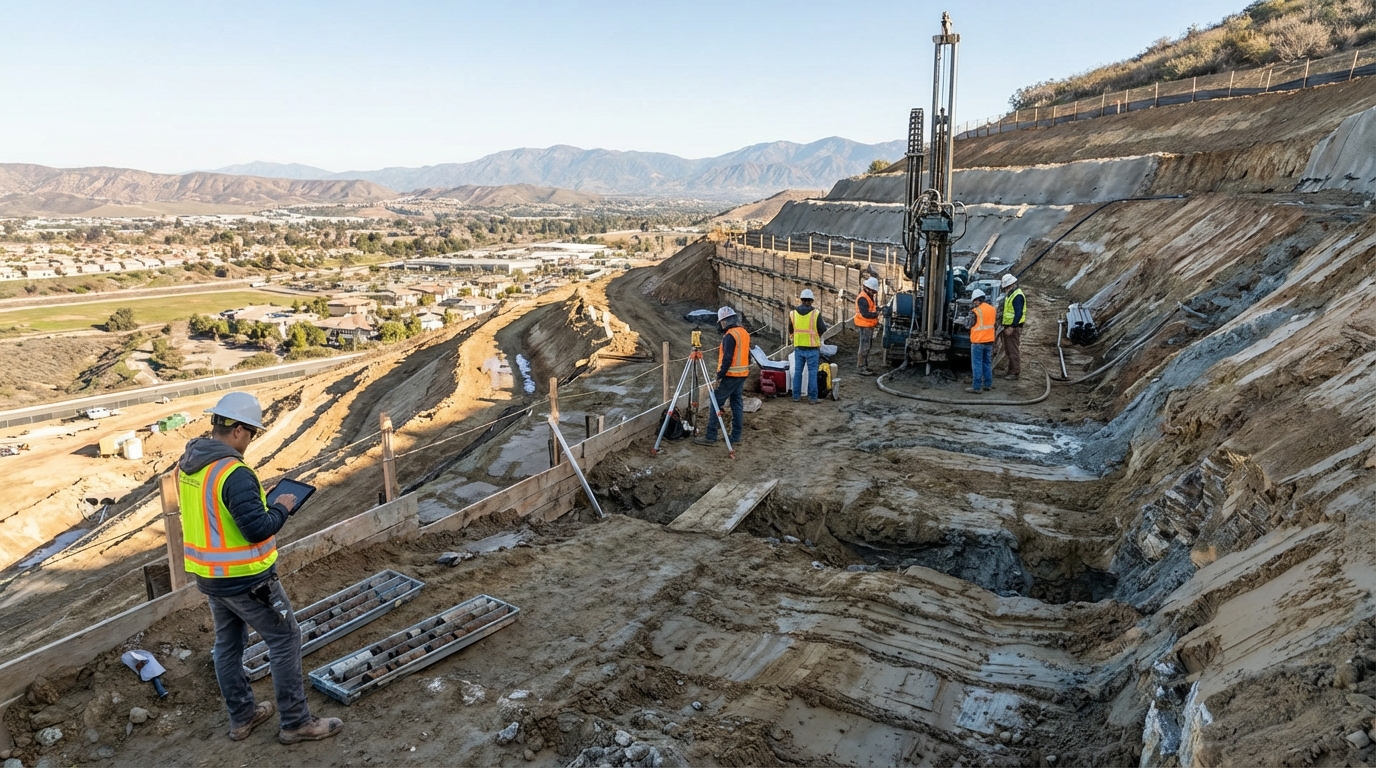
Soil engineers conduct subsurface exploration using truck-mounted drilling equipment or hand auger methods depending on site access conditions. Boring logs document soil composition at continuous intervals, noting visual classifications, groundwater table depth, and soil texture changes. Civil engineers mark locations where water table fluctuation has occurred based on soil structure indicators such as oxidation staining or moisture content testing results. During Southern California winter months, geotechnical investigation schedules account for soil drying time of 48-72 hours following rainfall events exceeding 1 inch.
Phase 2: Laboratory Testing (5-7 Days)
Soil samples undergo classification testing per ASTM D2487 to determine soil gradation and assign USCS designations (CL for clay, SM for silty sand, GW for well-graded gravel). Laboratory analysis measures moisture-density relationship through modified Proctor testing (ASTM D1557), establishing baseline compaction requirements. Test results quantify soil compressibility, plasticity characteristics, and soil porosity that influence foundation design considerations. Wet soil samples California laboratories process require extended drying periods, adding 2-3 days to standard turnaround times.
Phase 3: Engineering Analysis and Recommendations (2-3 Days)
Geotechnical engineers evaluate soil behavior under anticipated loading conditions, calculating settlement potential and bearing pressure limits. Foundation soil reports specify minimum footing widths, embedment depths, and reinforcement requirements. Construction specifications address soil stabilization methods for wet conditions, including lime treatment (5-8% by weight for cohesive soils) or cement stabilization (6-10% for granular soils). Winter-specific recommendations cover construction sequencing to avoid muddy conditions and equipment limitations that reduce construction geology site productivity by 40-60%.
Common Misconceptions About Winter Soil Testing
Myth: Summer Soil Reports Remain Valid During Winter
Reality: Ground conditions assessment expires when seasonal soil changes alter moisture content by more than 4% from tested conditions. According to soil consultant industry standards, reports older than 6 months require field verification during rainy season. Soil mechanics principles show that effective stress changes when groundwater analysis reveals water table rises of 3 feet or more, invalidating original foundation recommendations.
Myth: All SoCal Soils Behave Similarly in Wet Weather
Reality: Southern California soil types exhibit distinct winter behavior patterns. Coarse-grained soils maintain 70-80% of dry-season bearing capacity during wet weather California conditions, while fine-grained soils lose 50-70% of original strength. Expansive soils in Riverside County and San Bernardino County demonstrate volume changes 3-4 times greater than coastal Orange County sandy soils when exposed to equivalent precipitation levels (USGS Regional Soil Survey, 2023).
Myth: Compaction Testing Isn’t Necessary During Wet Periods
Reality: Compaction standards during wet weather require more frequent verification, not less. California building code soil requirements mandate density testing at 2,500 cubic yard intervals during dry conditions but reduce intervals to 1,000-1,500 cubic yards when field moisture content exceeds optimum by 2% or more. Soil trafficability assessment determines when equipment can access graded areas without causing remolding or pumping of subgrade soils.
Soil Stability Report vs. Standard Geotechnical Report
Standard geotechnical reports provide site soils evaluation for typical construction conditions, focusing on bearing capacity, settlement analysis, and basic grading specifications. These building site analysis documents assume relatively stable moisture content and seasonal groundwater levels. Soil stability reports for Southern California winter conditions expand scope to address dynamic ground behavior during rainfall events, incorporating stormwater management requirements, temporary erosion control measures, and workability conditions that affect construction timelines.
Geotechnical analysis for standard reports costs $2,500-$4,500 for residential sites up to 10,000 square feet. Winter-focused soil conditions evaluation adds $800-$1,500 to cover additional moisture testing, percolation testing, and wet season soil testing procedures. The enhanced investment prevents construction delays averaging $3,000-$8,000 per week when unanticipated ground water conditions halt grading operations (California Construction Cost Index, 2024).
Practical Applications for Contractors
Foundation Inspection and Design
Foundation engineering requires soil strength parameters that account for worst-case seasonal conditions. Contractors use soil report requirements to specify continuous footings at minimum 18-inch depth below finish grade in non-expansive areas, increasing to 24-30 inches in high-plasticity clay zones. Post-tensioned slab foundations incorporate moisture barriers and edge thickening based on soil load capacity calculations that assume saturated conditions persisting 45-90 days annually in typical El Niño years.
Grading Operations and Site Preparation
Construction site evaluation determines optimal grading windows when soil moisture levels permit efficient earthwork. Contractors schedule rough grading during extended dry periods (minimum 5 consecutive days without rainfall for clay soils, 3 days for sandy soils). Best practices for winter excavation Southern California projects include stockpiling dry material before November, implementing drainage analysis systems that direct surface water away from cut slopes, and maintaining equipment access roads at 95% compaction even during wet periods.
Slope Stability Management
Slope stability during rainy season Southern California construction requires interim measures beyond permanent drainage requirements. Geotechnical recommendations specify temporary slope angles of 2:1 (horizontal:vertical) or flatter for clay soils when rainfall exceeds 4 inches within any 7-day period. Contractors install silt fencing, fiber rolls, and hydroseeding within 48 hours of exposing slopes exceeding 10 feet in height to prevent soil erosion that can trigger building inspector red-tag conditions.
Winter-Specific Ground Conditions Considerations
Atmospheric Rivers and Intense Precipitation
Southern California atmospheric rivers deliver 30-60% of annual rainfall within concentrated 48-72 hour events, causing soil moisture levels to increase from 8-12% (optimal range) to 18-25% (saturated conditions) rapidly. According to NOAA Western Regional Climate Center data (2024), atmospheric river events occur 4-8 times per winter season, each capable of depositing 3-8 inches of rainfall. Contractors working during these wet ground conditions should halt earthwork when field observations show standing water persisting more than 4 hours after rainfall stops or when soil stickiness prevents proper compaction control.
Groundwater Table Fluctuations
The water table in Southern California valleys typically resides 15-40 feet below surface during summer months but can rise to within 3-10 feet of grade during prolonged rainy periods. Orange County and San Diego County coastal areas experience seasonal groundwater elevation changes of 8-15 feet, while inland Riverside County and San Bernardino County sites show 12-25 feet of water table fluctuation. Foundation design considerations must account for buoyancy forces and hydrostatic pressure when groundwater table monitoring indicates potential saturation of footing subgrade during winter months.
Soil Drying and Construction Readiness
Soil percolation rates determine how quickly construction readiness returns after rainfall infiltration events. Well-graded gravelly sand (GP or GW classifications) typically achieves workable moisture levels within 24-36 hours when exposed to moderate sunshine and wind. Clay soils (CL, CH classifications) require 5-10 days of dry weather to reach moisture content within 2% of optimum when initial saturation reaches 95% or higher. Contractor guidelines for winter soil conditions recommend moisture content testing at multiple depths (surface, 6 inches, 12 inches) before resuming compaction activities to ensure uniform drying has occurred.
Actionable Guidelines for SoCal Winter Construction
Construction companies should obtain soil analysis updated within 90 days of anticipated earthwork start dates for projects scheduled between November and March. Geotechnical services contracts should specify moisture testing frequency of twice weekly during active grading plus additional sampling within 24 hours following any rainfall event exceeding 0.75 inches. Civil engineers recommend establishing minimum compaction requirements of 92-93% (rather than standard 90%) for winter work to provide safety margin against moisture-induced strength loss. Building inspectors require documentation showing field density testing results meet specifications under actual as-built moisture conditions, not theoretical optimum conditions.
Successful winter construction projects incorporate drainage analysis that exceeds California Building Code minimum requirements, typically designing systems to handle 10-year storm events rather than code-minimum 5-year storms. Surface water management through strategic grading that maintains 2% minimum slopes away from structural areas prevents water retention that prolongs soil saturation periods. Equipment selection favors low-ground-pressure machinery (track-type dozers over wheeled scrapers) when ground bearing capacity analysis indicates marginal trafficability conditions during winter weather impact periods.