What Is the Difference Between Sonic and Auger Drilling?
The primary difference between sonic drilling and auger drilling lies in their penetration mechanisms: Sonic drilling uses high-frequency vibration and resonant frequency (typically 50-120 Hz) to advance boreholes, whereas auger drilling relies on rotational drilling and mechanical torque to cut through subsurface material. Sonic drilling achieves penetration rates 3-5 times faster than auger methods and produces higher-quality, undisturbed samples, but requires greater initial equipment costs ($500,000-$800,000 versus $150,000-$300,000 for auger rigs).
What Are the Core Mechanical Differences Between Sonic and Auger Drilling Methods?

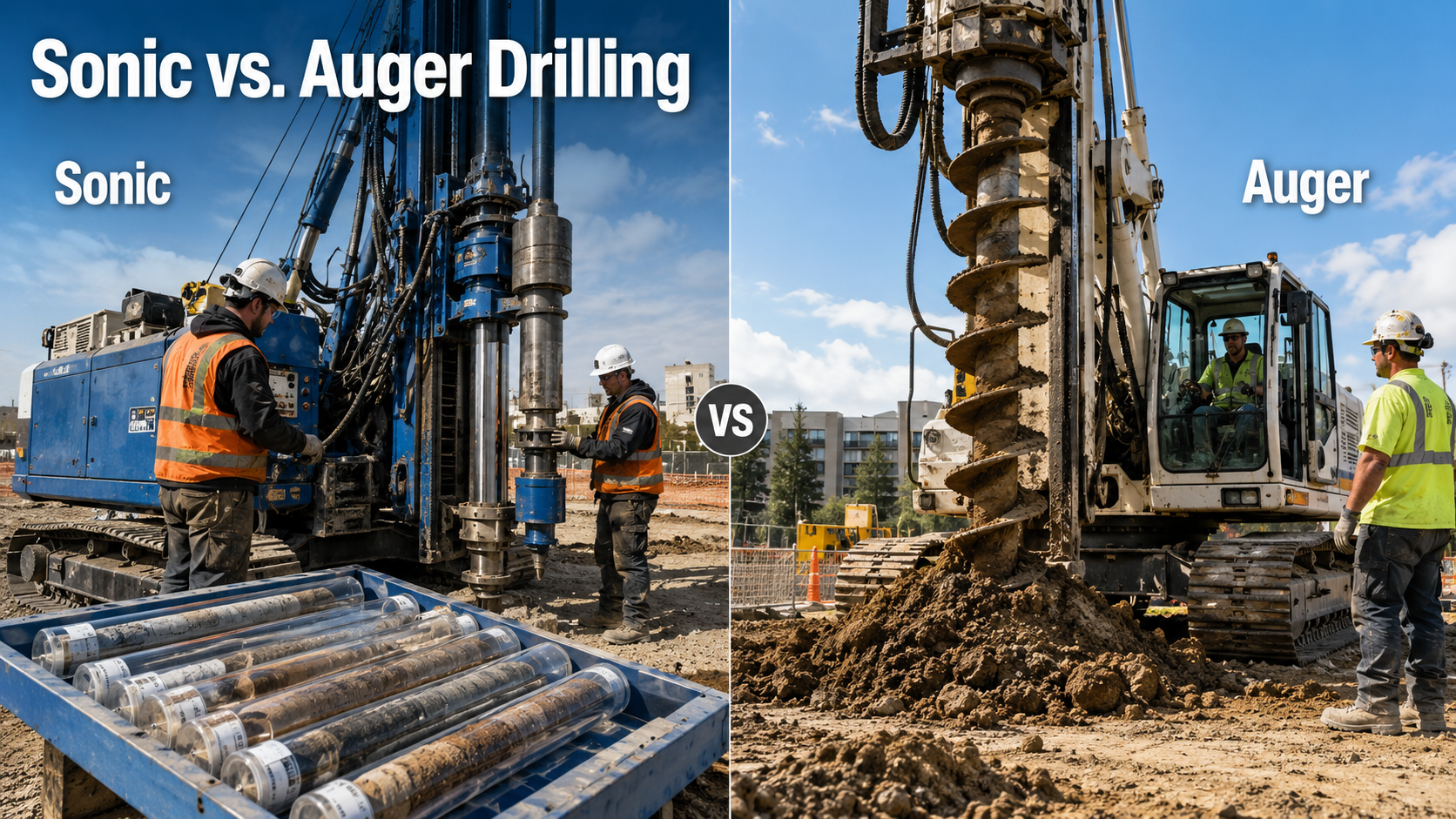
Sonic drilling, also known as resonant sonic or vibratory drilling, employs vibration technology to liquefy soil particles temporarily. The drill stem oscillates at frequencies between 50-120 Hz, creating a resonant effect that reduces friction between the drill bit and formation. This mechanical drilling process allows continuous coring through unconsolidated material, overburden, and even bedrock without drilling fluid.
In contrast, auger drilling uses rotary methods to physically cut and transport soil to the surface. Hollow stem auger drilling creates a borehole while maintaining structural integrity through a hollow center pipe, allowing sampling through the auger stem. Solid stem auger and bucket auger configurations remove cuttings through spiral flights, whereas continuous flight auger systems transport material continuously during rotation. According to the Geotechnical Engineering Journal (2024), auger drilling relies on torque ranging from 10,000 to 40,000 ft-lbs depending on formation conditions.
| Feature | Sonic Drilling | Auger Drilling |
|---|---|---|
| Drilling Mechanism | High-frequency vibration (50-120 Hz) | Rotational cutting with mechanical torque |
| Penetration Rate | 150-300 feet per hour in optimal conditions | 30-80 feet per hour in typical soils |
| Sample Quality | Undisturbed samples with 95%+ core recovery | Disturbed samples, 60-85% recovery |
| Drilling Depth Capacity | Up to 1,500 feet with specialized equipment | Typically limited to 200-300 feet |
| Equipment Cost | $500,000-$800,000 initial investment | $150,000-$300,000 for standard rigs |
| Best Applications | Environmental site assessment, contaminated soil sampling | Shallow soil investigation, geotechnical sampling |
| Formation Disturbance | Minimal disturbance to surrounding formation | Moderate to high disturbance from cutting action |
| Cross-Contamination Risk | Low (no drilling fluid required) | Moderate (cuttings travel along flight) |
How Does Drilling Speed Compare Between Sonic and Auger Methods?

Sonic drilling demonstrates superior drilling velocity in most subsurface conditions. Field data from environmental drilling contractors (Environmental Drilling Magazine, 2024) indicates sonic rigs achieve penetration rates of 150-300 feet per hour through unconsolidated sediments, compared to 30-80 feet per hour for conventional auger drilling systems. This drilling efficiency comparison shows sonic methods complete boreholes 3-5 times faster than rotary drilling alternatives.
The drilling productivity rates advantage stems from sonic oscillation reducing friction at the drill bit interface. Unlike auger systems that must mechanically cut through each soil layer, vibratory methods temporarily liquefy material, requiring less energy for formation penetration. In drilling through various formations including clay soils, sandy soils, and mixed lithology, sonic drilling maintains consistent drilling operation efficiency.
However, auger drilling speed varies significantly with formation type. Hollow stem auger drilling advances rapidly through soft clays at 60-100 feet per hour but slows to 10-20 feet per hour when encountering cobbles and boulders. Bucket auger drilling proves effective for shallow drilling applications, achieving 40-80 feet per hour in the first 50 feet of overburden. The drilling time savings with sonic methods become most pronounced in geotechnical investigation projects requiring depths exceeding 100 feet.
Which Method Provides Superior Sample Quality and Integrity?
Sonic drilling produces significantly higher sample integrity for laboratory analysis and stratigraphic profiling. The continuous sampling methods employed by sonic rigs yield continuous core samples with minimal formation disturbance, achieving core recovery rates of 95-100% in most geological conditions. These undisturbed samples maintain in-situ moisture content, density, and structural characteristics essential for accurate soil profiling and formation characterization.
According to the American Society for Testing and Materials (ASTM D6914, 2023), sonic core drilling provides “essentially undisturbed samples suitable for all laboratory testing protocols.” The minimal disturbance drilling approach preserves delicate soil structures, making sonic methods ideal for sampling accuracy in environmental site characterization and contaminated site drilling where precise contamination profiling is required.
Auger drilling typically produces disturbed samples due to the cutting and mixing action of the drill bit and flights. Sample quality from hollow stem auger drilling ranges from moderately disturbed (when using split spoon sampling or shelby tube sampling techniques) to highly disturbed (from auger cuttings). Core sample integrity decreases as auger diameter increases and rotation speed accelerates. Environmental drilling technologies using auger methods typically achieve 60-85% sample recovery, with significant material loss in non-cohesive sandy soils.
For projects requiring undisturbed soil samples—such as vadose zone sampling, detailed lithologic logging, or geologic mapping—sonic drilling methods demonstrate clear advantages. Conversely, when disturbed samples suffice for basic soil characteristics identification or when drilling cost considerations outweigh sample quality requirements, auger drilling provides adequate results.
What Is the Cost Comparison Between Sonic and Auger Drilling?
The drilling cost analysis reveals substantial differences in both capital investment and operational expenses. A sonic rig requires an initial equipment cost of $500,000-$800,000, compared to $150,000-$300,000 for a standard hollow stem auger rig (Drilling Equipment Report, 2024). This three-fold difference in drilling equipment costs creates significant barriers for smaller drilling contractors entering the sonic drilling market.
However, operational drilling efficiency factors favor sonic methods. The faster drilling speed comparison translates to reduced labor hours and mobilization costs. A typical environmental drilling project requiring ten monitoring wells to 150 feet depth takes 5-7 days with sonic drilling versus 12-15 days using auger methods. When accounting for crew costs ($150-$200 per hour for a two-person team), the most cost effective drilling method depends on project scope and drilling depth capacity requirements.
Mobilization costs for sonic drilling equipment range from $3,000-$8,000 due to larger drill rig weight and specialized transport requirements. Standard auger rig mobilization typically costs $1,500-$3,000. For remote site drilling or urban drilling applications with limited access, these logistics costs significantly impact overall project budgets.
Drilling productivity comparison studies indicate sonic methods become cost-competitive for projects requiring:
- More than 500 cumulative feet of drilling
- Depths exceeding 100 feet per borehole
- Multiple boreholes at a single site (more than 8-10 locations)
- Undisturbed sampling requirements that would require additional sampling techniques with auger methods
When Should You Choose Sonic Drilling Over Auger Drilling?
Use Case 1: Environmental Site Assessment with Groundwater Sampling
Sonic drilling excels in environmental site assessment projects requiring precise contamination mapping. When investigating contaminated soil at industrial sites, the minimal cross contamination prevention capabilities of sonic methods prove critical. Unlike auger drilling, which can drag contaminants vertically through the borehole, sonic drilling advances with sealed core barrels that maintain stratigraphic integrity.
For groundwater monitoring well installation in contaminated aquifers, sonic drilling methods eliminate the need for drilling fluid that could introduce foreign materials or alter formation chemistry. The drilling through multiple soil layers capability allows rapid penetration through varying lithology while maintaining distinct layer identification. Projects requiring EPA compliance and OSHA regulations adherence benefit from the reduced environmental impact and worker exposure associated with sonic drilling systems.
Use Case 2: Deep Geotechnical Investigation
When geotechnical drilling projects require depths exceeding 200 feet, sonic drilling provides superior depth capabilities and formation penetration. The best method for deep drilling in consolidated formations and bedrock involves sonic oscillation combined with rotary percussion. Unlike auger drilling, which faces mechanical limitations at depths beyond 200-300 feet due to drill stem weight and torque requirements, sonic rigs routinely advance boreholes to 500-1,500 feet.
For subsurface investigation targeting bedrock characteristics or deep aquifer testing, sonic drilling maintains consistent penetration rates regardless of depth. This drilling versatility proves essential for large infrastructure projects, bridge foundations, or geological survey work requiring comprehensive stratigraphic data from surface to bedrock.
Use Case 3: Drilling Through Difficult Soil Conditions
The advantages of sonic drilling over auger drilling become most apparent when encountering challenging subsurface exploration conditions. Drilling in difficult conditions such as cobble layers, boulder zones, or cemented soils frequently stalls conventional auger equipment. According to field data from drilling contractors (2024), auger systems experience 40-60% reduction in penetration rates when encountering gravel layers exceeding 30% by volume.
Sonic drilling maintains steady advancement through drilling through cobbles and boulders due to the liquefaction effect of high-frequency drilling oscillation. The vibration technology fractures and displaces obstructions without requiring tool changes or drilling method adjustments. For optimal drilling technique in glacial till, alluvial deposits, or colluvium containing mixed particle sizes, sonic methods deliver consistent drilling operation efficiency.
Use Case 4: Shallow Soil Sampling for Routine Investigations
Despite sonic drilling advantages, auger methods remain preferred for specific applications. When is auger drilling preferred over sonic? Projects involving shallow drilling (less than 50 feet), routine soil investigation methods, or limited budgets benefit from auger drilling cost advantages and equipment availability.
Hollow stem auger drilling provides excellent results for standard geotechnical sampling techniques including split spoon sampling at regular intervals. The best method for shallow drilling in homogeneous soil conditions involves continuous flight auger or bucket auger systems that offer rapid, economical borehole advancement. For agricultural applications, utility installations, or preliminary site characterization where sample quality requirements are moderate, auger drilling delivers adequate results at significantly lower cost.
What Are the Environmental Impact and Compliance Considerations?
Sonic drilling generates less environmental impact in several critical areas. The drilling without drilling fluid requirement eliminates disposal of potentially contaminated fluids and reduces water consumption by 500-2,000 gallons per borehole compared to mud rotary or air rotary methods. This advantage becomes particularly significant for remediation projects in environmentally sensitive areas or regions with water use restrictions.
Noise levels from sonic drilling vs auger drilling differ substantially. Sonic rigs produce 90-105 decibels during operation due to the hydraulic system and oscillation mechanism, compared to 75-85 decibels for typical auger equipment. Urban drilling applications in residential areas or near hospitals may face restrictions on sonic drilling hours, requiring noise mitigation measures or scheduling modifications to maintain environmental compliance drilling standards.
Both methods meet EPA compliance requirements when properly executed, but sonic drilling offers inherent contamination prevention advantages. The sealed core barrel system prevents cross-contamination between vertical zones, a critical consideration for remediation wells or monitoring wells at Superfund sites. OSHA regulations regarding worker exposure to drilling vibration require proper equipment maintenance and operator training for sonic systems.
How Do Drilling Equipment and Mobilization Requirements Compare?
Sonic rig configurations typically weigh 30,000-60,000 pounds and require specialized transport on flatbed trailers or heavy-duty trucks. The drilling equipment selection process must account for site access limitations, with some sonic rigs requiring 12-foot clearance width and stable ground conditions to support outrigger stabilizers. In contrast, smaller auger rig designs weigh 8,000-25,000 pounds and mount on truck chassis, providing greater mobility for drilling in tight access areas.
The drilling tool configuration differs significantly between methods. Sonic drilling systems include the drill head (containing oscillation mechanism), drill stem (typically 10-foot sections), core barrel, and specialized core catchers. Auger drilling equipment comprises the drill head (providing rotation and downward pressure), auger flights (in 5-foot sections), center rod, and sampling tools. The drilling system components for sonic rigs involve more complex hydraulic systems and electronic controls, requiring operators with specialized training.
For drilling diameter options, sonic methods typically range from 4 to 12 inches, with larger diameters (up to 24 inches) available for specialized applications. Auger drilling commonly uses 4 to 10-inch hollow stem augers, with bucket auger diameters reaching 24-48 inches for excavation-style applications. The advanced drilling technology in modern sonic rigs includes real-time drilling parameter monitoring, automated frequency adjustment, and GPS positioning for precise borehole location documentation.
Decision Framework: Selecting the Optimal Drilling Technique
Choose sonic drilling when:
- Project requires undisturbed samples for laboratory testing or detailed soil characteristics analysis
- Drilling depth exceeds 100 feet or targets deep aquifers
- Site contains contaminated material requiring strict cross-contamination prevention
- Subsurface conditions include cobbles, boulders, or cemented layers
- Sample recovery rates above 90% are necessary for formation identification
- Multiple boreholes (8+) justify higher mobilization costs through drilling time savings
- Environmental compliance requires elimination of drilling fluids
- Project timeline demands rapid drilling methods and high drilling productivity rates
Choose auger drilling when:
- Drilling depth remains below 100 feet in relatively soft formations
- Budget constraints require minimizing drilling equipment costs and mobilization costs
- Disturbed samples provide adequate data for project objectives
- Site access limitations prevent deployment of larger sonic rigs
- Noise restrictions prohibit high-decibel drilling operations
- Single or few boreholes make sonic mobilization cost-prohibitive
- Soil conditions consist of homogeneous clay soils or sandy soils without significant obstructions
- Project involves routine geotechnical sampling or preliminary subsurface investigation
The drilling method selection should evaluate total project costs rather than focusing solely on daily rates. While sonic drilling equipment carries higher initial costs, the drilling efficiency comparison demonstrates that sonic methods often deliver lower total project costs for medium to large-scale investigations. Conversely, auger drilling remains the most cost effective drilling method for shallow, straightforward applications where sample quality requirements are moderate.
For comprehensive guidance on sonic vs auger drilling methods and project-specific recommendations, consult with experienced drilling contractors who maintain both equipment types and can provide objective drilling solutions based on site-specific subsurface conditions and project requirements.